How to Fight Back Against AI Search Traffic Loss (And Actually Win)
How to Fight Back Against AI Search Traffic Loss (And Actually Win)
By Damon Nelson
If you've been watching your traffic numbers lately, you already know something is wrong.
The rankings are still there. The content is still published. But the clicks? They're disappearing. And if you're anything like most online marketers right now, you've probably been refreshing your analytics hoping it's a glitch — only to realize it's not.
It's not a glitch. It's a fundamental shift in how search works.
Google AI Overviews, ChatGPT Search, Perplexity, Gemini — these platforms are now answering questions for your visitors before they ever reach your site. Studies show that over 70% of searches now end without a click, and organic click-through rates have dropped by as much as 61% for queries where an AI Overview appears. For affiliate publishers, it's even more personal — close to 7 in 10 affiliate publishers say they're concerned these changes will hurt their business.
Here's the truth nobody wants to say out loud: the old SEO playbook is broken.
But — and this is the part that matters — the traffic isn't gone. It's just been redirected into AI-generated answers. And that means the fight-back strategy isn't about fighting AI. It's about getting inside the answer.
Let me show you how.
Why Ranking #1 Doesn't Mean What It Used To
This is the thing that trips most people up.
You might still rank number one on Google. Your content might be excellent. But if an AI system generates a summary answer at the top of the page and your link is buried below it, most users never scroll down. The click never happens.
What's even more counterintuitive is this: fewer than 10% of sources cited in ChatGPT, Gemini, and Copilot responses actually rank in the top 10 Google organic results for the same query. Read that again. There are now two separate competitions happening — your Google rank and your AI citation rank. Winning one doesn't mean winning the other.
Here's the flip side, and this is where it gets interesting: brands that do get cited in AI Overviews earn 35% more organic clicks and 91% more paid clicks than brands that don't. So clicks aren't dead. They just now reward the cited source, not just the highest-ranked one.
The question you need to start asking isn't "What's my Google rank?" It's "Does the AI recommend me?"
The New Metric: AI Share of Voice
Before we get into tactics, there's a mindset shift that has to happen first.
The most important number in your marketing dashboard going forward isn't CTR. It isn't even organic traffic. It's AI Share of Voice — how often and how favorably AI platforms mention your brand when someone asks about your topic.
This reframing changes everything: what you produce, how you structure it, where you build authority. The new discipline built around this idea even has a name: Generative Engine Optimization, or GEO.
If traditional SEO is about ranking on page one, GEO is about being part of the answer itself. And the brands that figure this out now — while most of their competitors are still staring at their declining traffic stats in disbelief — have a serious first-mover advantage.
Here's exactly how to build that advantage across five pillars.
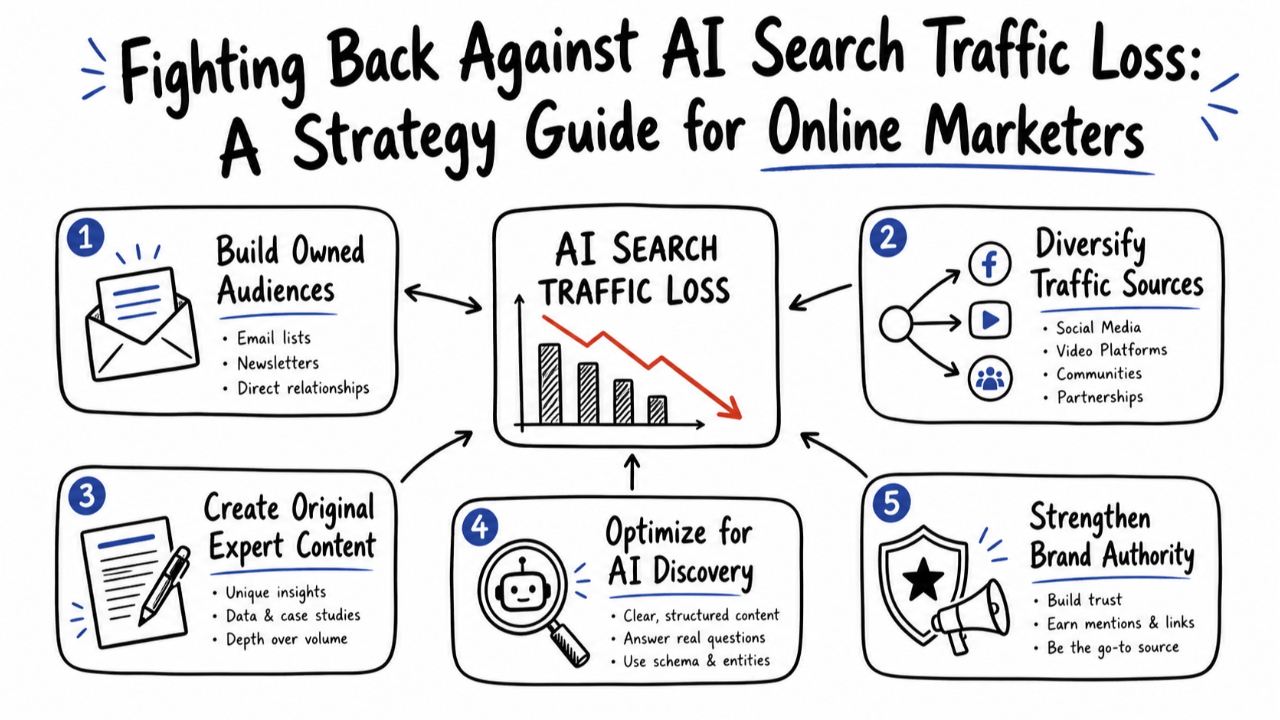
Pillar 1: Master Generative Engine Optimization (GEO)
GEO is not a replacement for SEO. It's an additional layer of optimization specifically built for AI retrieval. And the good news is, a lot of it comes down to how you format and structure your existing content.
AI engines are answer machines. They scan for the clearest, most extractable answer available, then pull it directly into their response. If your content buries the answer in the fifth paragraph after 300 words of background, you're invisible to them. If your content leads with a crisp, direct answer and supports it with structured data and evidence — you get cited.
Here's what that looks like in practice:
-
Answer first, always. Open every article by directly answering the core question. Don't make the AI hunt for it.
-
Use structured data. Implement FAQ, HowTo, and Article schema markup on your pages. This is how you become an answer engine's preferred source. Content structured with comparison tables is 58% more likely to be cited than paragraph-form content covering the same ground.
-
Write in short, extractable paragraphs. Two to three sentences max. Use bullet points, bolded summary lines, and H2 headings framed as actual questions. AI engines pull clean passages — not walls of text.
-
Lead with data. Content with specific, verifiable statistics is 25–40% more likely to be cited by AI. Every factual claim you make should have a number behind it.
-
Go deep on fewer topics. Build comprehensive pillar pages, glossaries, and methodology guides rather than publishing shallow content across dozens of subjects. AI engines reward demonstrated topical authority.
-
Keep content fresh. AI engines favor recently updated content. Set a calendar reminder to systematically refresh your top-performing pages with new data, updated stats, and current examples every six months.
Pillar 2: Build Brand Authority That AI Engines Trust
This is the one most marketers are sleeping on — and it might be the highest-leverage move available right now.
A landmark study analyzing 36 million AI Overviews and 46 million citations found that 96% of AI citations go to sources with strong E-E-A-T signals — that's Google's framework for Experience, Expertise, Authoritativeness, and Trustworthiness. If your brand lacks these signals, you are functionally invisible to AI search, regardless of your organic rankings. In fact, mid-ranked pages with superior E-E-A-T outperform top-ranked pages by 2.3x in AI citation frequency.
Here's the thing about trustworthiness signals: they come from other people talking about you, not just from what you say about yourself. AI systems are built to corroborate — if multiple credible third-party sources reference your brand and validate your claims, the AI considers you reliable.
How to build AI-citation authority:
-
Earn media placements. 90% of AI citations come from earned media — third-party validation in recognized publications, industry outlets, and authoritative blogs. One feature in Forbes or a niche trade publication generates citation value for 18–24 months after it publishes.
-
Get into the knowledge graph. Make sure your brand exists on Google's Knowledge Graph, Wikidata, and Wikipedia where applicable. ChatGPT relies on Wikipedia for 47.9% of its citations. Pages with 15+ recognized entities have a 4.8x higher probability of appearing in AI Overviews.
-
Use author schema. Clear author bios with ProfilePage schema help AI systems identify your content as coming from a human expert with a verifiable track record — not just an anonymous website.
-
Add expert quotes. Research from Princeton and IIT shows that including expert quotes boosts AI visibility by up to 41% — the single highest-impact content change you can make right now. Start reaching out to industry voices for brief attributed quotes.
-
Publish original research. Proprietary data, surveys, benchmarks, and case studies are the content formats AI engines reward most. They provide "information gain" — new knowledge that isn't just a summary of existing sources. One good original study can generate citations for years.
-
Build brand mentions everywhere. Branded search volume has a 0.334 correlation with AI visibility, and branded web mentions score 0.392. Podcast appearances, newsletter features, forum engagement — every mention is a signal the AI picks up on.
Pillar 3: Stop Depending on Google (For Real This Time)
If there's one lesson the last five years of algorithm updates should have taught us, it's this: building your entire traffic engine on a platform you don't control isn't a strategy. It's a liability.
The AI search era is the final proof. It's time to build an audience you actually own.
The smartest move right now is converting your existing visitors into subscribers before traffic drops further. An email list is the most AI-proof asset in digital marketing — no algorithm controls it. And in the post-third-party-cookie era, first-party data collected directly from your audience is worth more than it has ever been.
Where to build beyond Google:
-
Email first. Launch or upgrade your lead magnets, pop-ups, and content upgrades right now. Every page that still has traffic is a subscriber acquisition opportunity you can't afford to waste.
-
YouTube. YouTube is both a standalone search engine and a platform heavily cited in AI-generated responses. One B2B case study reported a 35% overall sessions increase, with 25% of new sign-ups coming from YouTube and email after building a consistent video presence. Multimodal content wins disproportionately in AI citations.
-
Communities. Reddit, Facebook Groups, Discord servers, and niche forums aren't just places to drive traffic — Reddit is among the top five most-cited domains across AI Overviews. Building real expertise in communities generates traffic, brand mentions, and AI citation signals simultaneously.
-
Social platforms. X (Twitter) referrals are up 15% year-over-year and Facebook up 9% globally despite overall search volatility. The key is platform-native content — not just links to articles — and genuine community engagement.
-
Podcasts and newsletters. Guest appearances on relevant podcasts and industry newsletters compound authority across both human audiences and AI citation databases. Every quality guest appearance is earned media working double duty.
Pillar 4: Optimize for Every AI Platform, Not Just Google
Here's something most people haven't thought about yet: Google AI Overviews isn't the only AI search surface that matters. ChatGPT, Perplexity, and Microsoft Copilot are all growing fast as primary search interfaces — and they each draw from different source pools with different rules.
A complete GEO strategy has to be multi-platform.
The practical move is simple: once a month, search your 20 most important queries in ChatGPT (with browsing on), Perplexity, and Google AI Mode. Who is getting cited? What language are they using? What content format are they pulling from? That becomes your editorial brief for the next 30 days.
This "AI visibility audit" — tracking which brands appear for your core topics across multiple platforms — should be a standard part of your analytics routine. The brands building this habit now will have months of competitive intelligence on everyone else by year's end.
Pillar 5: Rethink the Affiliate Model Before It Gets Rethought for You
This one is specifically for affiliate marketers — and it's the most urgent conversation in the industry right now.
OpenAI and Google are both building commerce protocols that let transactions happen directly inside AI interfaces through instant checkout and agentic purchasing. The affiliate click, as the core transaction unit, is under structural threat. Not eliminated — but disrupted. The window to adapt is open now, while the shift is still unfolding.
How to evolve the model:
-
Move to multi-touch attribution. As AI chatbots intercept the discovery and consideration phases of the buyer journey, click-based attribution undercounts your actual influence. Multi-touch attribution models capture your content's role even when the final click happens somewhere else.
-
Double down on first-person experience content. AI systems are increasingly good at detecting thin or AI-generated affiliate reviews. First-person testing, real photos, hands-on video comparisons — these are the formats that both convert better and earn more AI citations. This is the content that separates you from the flood of AI-generated review sites.
-
Know which LLMs recommend you. Start tracking which AI platforms cite your content for specific product categories. The affiliate marketers who know "ChatGPT recommends my review for [product type]" are playing a completely different game than those still watching Google keyword rankings.
-
Build owned products. Publishers depending purely on affiliate commissions from Google traffic are the most exposed group in this transition. Building owned digital products, courses, communities, or services creates revenue streams no algorithm can touch.
Your 90-Day Fight-Back Plan
All of this is only useful if you actually act on it. Here's a realistic roadmap broken into three phases:
Month 1 — Audit and Foundation
-
Run your AI visibility audit: search your 20 most important queries in ChatGPT, Perplexity, and Google AI. Note who appears, what format their content takes, and what language they use.
-
Implement FAQ and HowTo schema on your top 10 pages.
-
Aggressively add email opt-ins to every high-traffic page — upgrade lead magnets if you haven't touched them in over a year.
Months 2–3 — Content Transformation
-
Rewrite your top 10 content pages to answer-first, fact-rich, citation-ready format.
-
Add comparison tables, expert quotes, and original data points to your highest-performing articles.
-
Launch — or restart — a YouTube or short-form video presence around your core topics.
Months 4–6 — Authority and Diversification
-
Execute a targeted earned media campaign: guest posts, podcast appearances, industry publication pitches. One quality placement per month compounds fast.
-
Build or deepen your community presence on the platforms where your audience is actually active.
-
Begin systematic AI monitoring — track citation frequency monthly and let it guide your content calendar.
Ongoing
-
Track AI Share of Voice as a core KPI alongside traffic and revenue.
-
Publish at least one original research piece or proprietary data study per quarter.
-
Refresh your top evergreen content every six months with updated statistics and current examples.
The Bottom Line
The brands that adapt early to AI search have a real, time-limited window to establish citation dominance before the competition catches up. And the early-mover numbers are already compelling: one publisher achieved a 2,300% increase in monthly AI referral traffic through topical authority building and FAQ schema. Another saw a 340% increase in AI brand mentions within six months of a structured authority-building campaign. A client cohort reported 67% more AI citations within four months of implementing GEO best practices.
The zero-click era is brutal for passive marketers waiting for an algorithm reversal that isn't coming. But it's genuinely exciting for those willing to learn the new rules and move fast.
Stop fighting AI search. Get inside the answer. Build the brand that AI engines trust. Own your audience so no update can take it away.
That's how you win.
Stay connected with the most current Marketing News, Strategies, Tips , and Case Studies!
Join our monthly marketing magazine to receive the latest news and updates from our team of professional marketers and copywriters.
(Don't worry, your information will not be shared.)

Recent Posts
Expert Marketers Interviews
Listen to the Podcasts