
AI is simple - Find the problem. Build the antidote.
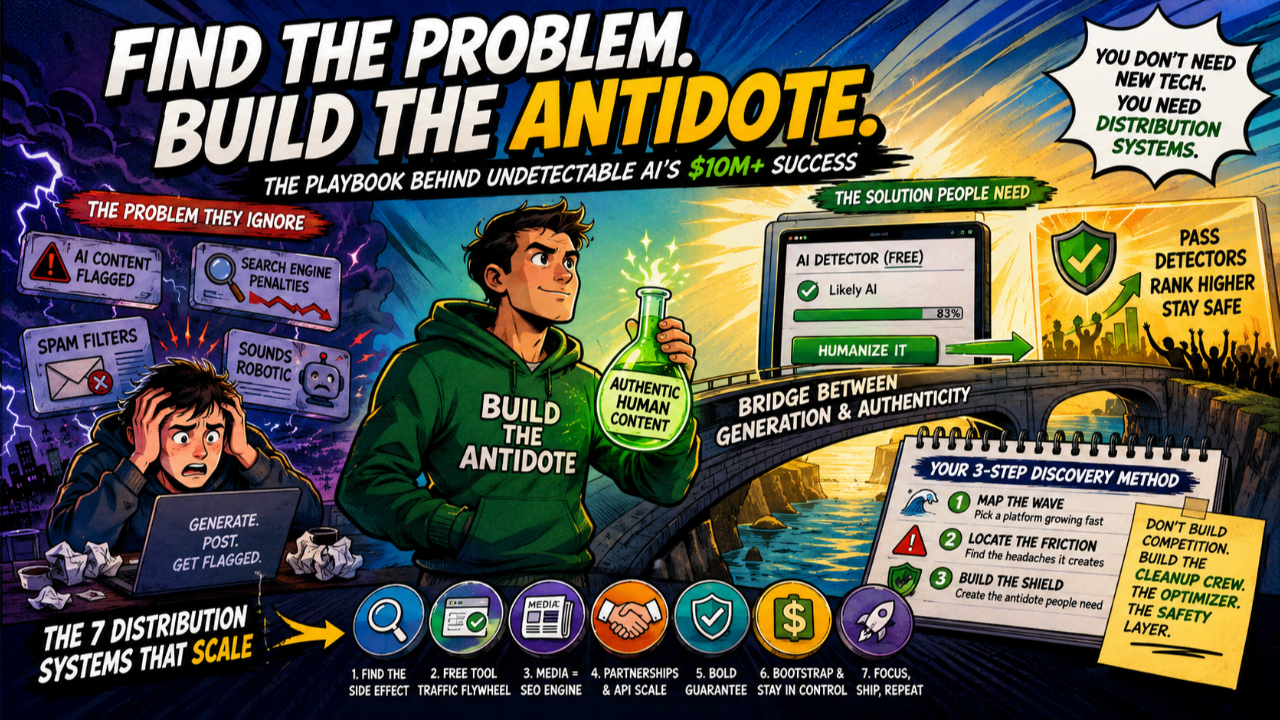
The Playbook Behind an Undetectable AI Developer's $10,000,000 Success
Every day, I watch smart builders make the same painful mistake. They hide for months and try to invent brand-new tech.
They think deep code is the moat. But in today’s market, distribution is often the real advantage.
One name makes this lesson easy to understand: Christian Perry. He did not build OpenAI, and he did not invent large language models.
Yet he bootstrapped Undetectable AI to over $10M in annual recurring revenue and 20 million users in under two years. He did it without venture capital and without huge ad budgets.
So what did he do instead? He built clear systems for discovery, traffic, trust, partnerships, conversion, and control.
Let’s walk through that playbook in plain language, so you can use it too.
1) Stop Building “Better Tech” and Start Solving the Mess It Creates
Think “side effects,” not “features”
When a big platform grows fast, it creates new problems. Those problems feel like headaches that show up after adoption.
That’s where opportunity lives. Not in copying the platform, but in fixing what it breaks.
When ChatGPT took off in late 2022, people rushed to generate content. Then a new problem hit right away.
The writing often sounded robotic. It also got flagged by search engines, spam filters, and schools.
Perry didn’t try to build a better text generator. As he put it, he focused on the “antidote” to the pain.
He built a bridge between generation and authenticity. That’s a cleaner business angle than another wrapper tool.
A simple 3-step discovery method you can reuse
If you want to copy this approach, use a repeatable checklist. You don’t need a genius idea. You need a clear target.
- Map the wave: Pick a platform growing fast, with real user demand.
- Locate the friction: Ask what goes wrong after people start using it.
- Build the shield: Create a tool that reduces penalties, risk, or wasted time.
Here’s the key mindset shift. If a giant launches an automated tool, don’t race them head-on.
Build the cleanup crew. Build the optimizer. Build the safety layer.
2) Use Free Utility Tools to Pull in Organic Traffic
Give the “diagnosis” away, then charge for the “fix”
Paid ads can work, but they are expensive and crowded now. Many solo founders burn cash before they learn what converts.
Perry built an organic traffic machine by offering a free tool people actively search for.
Undetectable AI puts a free, multi-model AI text detector right on the front page. You paste text and see how it performs across detectors.
That free check brings in high-intent visitors. They arrive already worried about a real problem.
Then the offer becomes obvious. If the text is flagged, you see a button to “Humanize” it.
Checking is free. Fixing requires a paid plan. The next step feels natural, not pushy.
Build your own “free tool” flywheel
You can apply the same pattern in almost any niche. The trick is to match the tool to a painful search query.
- Identify the diagnostic: Build a simple checker that reveals a problem.
- Own the intent: Target search terms people use when they feel stuck.
- Embed the solution: Put your paid offer right under the results.
Think of it like a free blood pressure test at a pharmacy. The test is free because it leads to action.
Your product is the action people want right after they see the result.
3) Use Media Features as an SEO Engine, Not an Ego Boost
Chase backlinks that raise your domain authority
Many founders chase press because it feels good. They want a logo wall and a victory lap.
Perry’s approach is colder and smarter. He treated earned media as an SEO multiplier.
Undetectable AI earned features and reviews on big outlets like Forbes, ZDNet, and Business Insider. The real prize was not the headline.
The prize was high-authority backlinks and trusted recommendations that push rankings up.
When a major site calls you a top option, it changes how Google and buyers see you. Your future posts and tools can rank faster.
Trust compounds, like interest in a bank account.
How a solo operator can pitch this the right way
You don’t need a PR agency to start. You need something useful and verifiable.
- Pitch the benchmark: Share data-backed tests, comparisons, or industry stats.
- Invite third-party testing: Encourage reviewers to stress-test your product.
- Compound the trust: Put those mentions on your landing page and checkout.
Transitioning from traffic to trust is where many products fail. Media trust signals help people relax.
They stop wondering, “Is this legit?” and start asking, “Will this work for me?”
4) Scale Faster with White-Label and API Partnerships
Let other businesses sell for you
If you rely only on one-by-one customer signups, growth can stall. Partnerships let you borrow someone else’s audience.
Perry built a system where agencies and software companies could resell the tool under their own brand.
The pitch was simple. “We handle the engineering and updates. You plug in our API or embed our tool.”
Then partners sell it to their existing customers. They earn margin, and you earn recurring B2B revenue.
A partnership checklist that works in many niches
This is not only for AI. It works for analytics, compliance, design, email, and more.
- Decouple the core: Package your service into a clean API or embed.
- Target asset holders: Pitch companies with customers who already need your add-on.
- Share the margin: Offer pricing that makes “build it ourselves” feel irrational.
Think of it like selling ingredients to restaurants instead of selling meals to diners. You move volume faster.
And you spend less time convincing each individual buyer.
5) Remove Risk with a Bold, Clear Guarantee
Make “no” feel harder than “yes”
In crowded markets, buyers expect disappointment. They assume the product will not match the promise.
Perry attacked that fear with a strong guarantee tied to the buyer’s real worry.
Undetectable AI makes a direct promise. If something it “humanizes” gets flagged by major detectors, they refund the cost of humanization.
That turns a risky purchase into a safer decision. It also signals confidence in the product.
How to design a guarantee that actually converts
A good guarantee is not a long legal document. It’s a simple promise in plain language.
- Find the core fear: Name the exact reason people hesitate to buy.
- Absorb the risk: Put the financial risk on your side, not theirs.
- Keep it frictionless: Put it near the price and checkout, not hidden.
Done right, your guarantee becomes part of your marketing. It also forces you to improve the product.
You can’t hide behind hype when refunds are easy.
6) Stay in Control by Bootstrapping and Protecting Focus
Fast money can create slow execution
When a tool grows fast, investors often show up with big checks. That can feel like winning.
But it can also bring pressure, meetings, and goals that don’t match your product.
Perry chose to skip venture capital. He bootstrapped using proceeds from a previous exit.
That choice gave him control over the roadmap and daily decisions.
His team stayed lean and distributed across countries. They focused on conversion tests, unit economics, and product refinement.
They didn’t spend weeks preparing investor decks.
Three focus rules you can use right now
You don’t need to copy every detail. But you can copy the discipline.
- Protect cash flow: Aim for profitability early, even if growth is slower.
- Optimize headcount: Use specialized contractors and global talent when needed.
- Pass on distractions: Say no to custom work that derails your main lever.
Real leverage is not raising money or hiring fast. It’s earning more per employee and keeping freedom.
If you want a one-person empire, autonomy is part of the product.
7) A 10-Minute Exercise to Find Your Next Micro-Niche
Do this on paper, not in another browser tab
Reading is easy. Execution is what changes your bank account.
So grab a notepad, set a 10-minute timer, and answer these three prompts.
- The booming platform: Identify one tech wave scaling fast right now.
Example: short-form video automation tools. - The residual headache: What penalty, risk, or admin nightmare does it create for users?
Example: platforms shadowban unedited, auto-generated clips. - The scalable antidote: What simple free utility could diagnose or reduce that side effect?
Example: a free “Shadowban Checker” that upsells a cleanup tool.
When you finish, you should have a clear “wave, headache, antidote” idea. That is enough to start building.
You can validate it with a landing page and a free tool before writing complex code.
What to Do Next
Pick one system and ship it this week
You do not need millions in funding. You also don’t need to be the best engineer in the room.
You need to find the headache, build the distribution funnel, and keep shipping.
If you want to take action today, choose one of these:
- Draft your “wave, headache, antidote” in 10 minutes.
- Outline a free diagnostic tool your audience would search for.
- Write a one-sentence guarantee that removes the biggest buying fear.
Then commit to one small build step in the next 48 hours. If you do, you’ll be ahead of most builders.
And if you try this framework, share what you picked. I’d love to see what headache you’re solving.
Stay connected with the most current Marketing News, Strategies, Tips , and Case Studies!
Join our monthly marketing magazine to receive the latest news and updates from our team of professional marketers and copywriters.
(Don't worry, your information will not be shared.)

Recent Posts
Expert Marketers Interviews
Listen to the Podcasts