Hope Is Not a Strategy: The 2026 Instagram Creator Playbook That Actually Sells
The 2026 Instagram Creator Playbook That Actually Sells
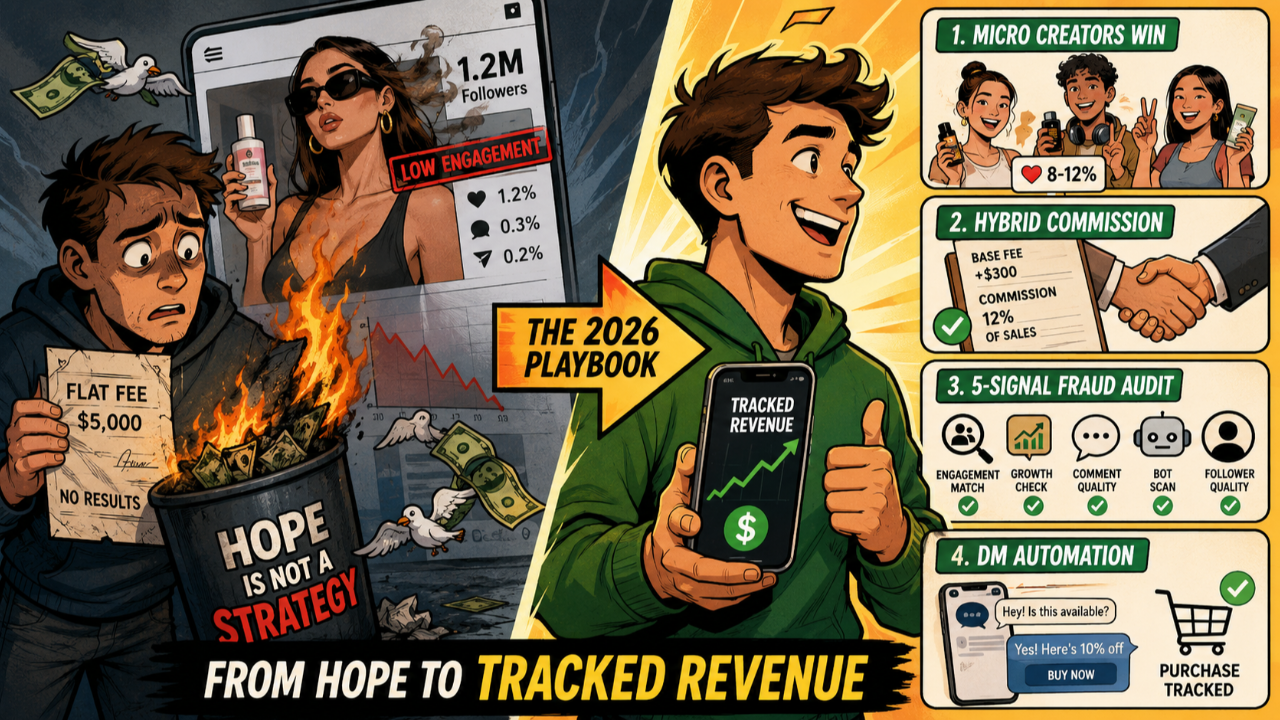
Why macro influencers and flat fees are quietly draining budgets — and how to switch to micro creators, hybrid commissions, a 5-signal fraud audit, and DM automation that turns views into tracked revenue.
Instagram marketing does not work like it used to. The old plan was simple. You paid a big influencer for one pretty post.
In 2026, that plan fails fast. People scroll past glossy ads. They trust real creators who feel like friends.
If you sell online, you need a new mindset. Creators are not “branding.” They are distribution channels that must drive sales.
1) The New Social Commerce Engine: Why Smaller Creators Win
Macro influence is fading, and buyers can feel it
Big celebrity-style sponsorships feel fake now. Many shoppers assume the creator does not even use the product.
That’s why many marketers moved money away from macro and mega creators. The shift is not about vibes. It is about performance.
The numbers behind micro and nano creators
Smaller creators often beat bigger ones on cost and trust. Many brands now favor nano and micro creators because they convert better.
- Micro creators (10K–100K): around $0.20 cost per engagement, with median CPM near $119.
- Macro creators (500K+): around $0.33 cost per engagement, with median CPM often $300+.
Here’s the simple reason. Bigger audiences usually trust less. Engagement often drops to 1% to 3%.
Nano creators can keep engagement around 8% to 12%. Their community feels close, like a group chat.
Think “portfolio,” not “one big bet”
Picture a $25,000 budget. If you spend it all on one macro creator, you are betting everything on one post.
A safer plan is to spread that budget. You can run a 50-creator micro campaign at $500 each. If five flop, the rest can still win.
You also get a bonus. You build a library of creator content you can reuse in ads, emails, and product pages.
2) The Hybrid Pay Model: How to Stop Overpaying for “Hope”
Flat fees are risky when sales are the goal
Paying one big fee upfront is like paying for a billboard. You might get attention. You might get nothing.
In 2026, you want alignment. The creator should earn more when you earn more.
The hybrid structure that protects your cash
The strongest setup is a hybrid deal. You pay a smaller base fee. Then you add a commission on tracked sales.
- Base fee covers time, filming, and editing.
- Commission is often 10% to 15% of tracked revenue.
For example, instead of paying $1,500 upfront, you might offer $300 plus 12% commission. Now the creator has a reason to push hard.
A simple rule for negotiations
If a creator refuses any commission, pay attention. It may mean they do not believe their audience will buy.
You do not need to argue. You can simply walk away and keep sourcing.
3) The 5-Signal Fraud Audit: How to Spot Fake Influence Fast
Fraud is not rare anymore
Influencer fraud is a real business threat. Many marketers say they have dealt with it in the past year.
Fake followers do not buy. They do not click. They just drain your budget.
Signal #1: Engagement that does not match follower count
Start with a quick reality check. If an account has 200,000 followers but only gets 200 likes, something is off.
- Low-end red flag: 0.1% to 0.2% engagement on posts.
- Healthy range: often 1% to 3% for larger accounts.
Also watch the other extreme. If a tiny account has “perfect” engagement every time, they may be in an engagement pod.
Signal #2: Sudden follower spikes with no clear reason
Real growth looks messy. It rises after a viral Reel, then settles down.
Fake growth often looks like a straight vertical jump. If they gain 15% to 20% followers in one week, ask why.
Signal #3: Copy-paste engagement patterns
Humans are inconsistent. One post hits. Another misses. That is normal.
If the last five posts have almost identical likes and comments, be suspicious. Bots can be programmed to “look steady.”
Signal #4: Low-quality comments
Spend 10 minutes reading comments. You will learn more than any dashboard.
- Watch for repeated phrases like “Nice!” or “Great post!”
- Watch for emoji-only comments with no context.
- If over 15% of comments look like this, move on.
Signal #5: Bot-like follower profiles
Click into their followers and sample 50 to 100 profiles. You are looking for empty accounts.
If more than 25% have no posts, no photo, and random usernames, the audience is padded.
Use tools, but still demand proof
Tools like HypeAuditor, Modash, and Celavii can speed up screening. Look for an Audience Quality Score.
If the score is below 60 out of 100, remove them from your list. Then ask for native screenshots of reach and Story views.
For an 80,000-follower account, real Stories often reach 3% to 8%. If they are under 1%, the audience may be asleep.
4) Contracts and FTC Rules: The Legal Stuff That Can Sink You
Handshake deals are not “friendly,” they are dangerous
It’s tempting to run partnerships through DMs. Many store owners do it because it feels faster.
But the risk is huge. You need a signed agreement before content is filmed and posted.
FTC disclosure rules must be clear and visible
Regulators have become more aggressive. Civil penalties per FTC violation can reach roughly $51,744 to $53,088.
That means one sloppy campaign can become a massive liability. So your contract needs strict disclosure rules.
- Above the fold: disclosure must be in the first line of the caption.
- Clear words: use “#ad,” “#sponsored,” or “Sponsored by.”
- No vague tags: “#collab” or “#partner” can fail standards.
- Dual layer: use both the platform label and caption disclosure.
Usage rights and “whitelisting” must be written down
Creators usually own what they make. If you run their video as an ad without permission, you can trigger a copyright fight.
Your contract should state usage length and where you can use it. Include paid ads, email, and product pages if needed.
Add a morality clause and a smart payment schedule
Your brand is tied to their behavior. A morality clause lets you end the deal if they create serious reputational risk.
Also, do not pay everything upfront. A common structure is 30% at signing and 70% after approval and compliance review.
5) Creator Pricing in 2026: What Content Actually Costs
Reels cost more because Reels reach more
Reels are the discovery engine. They often cost 15% to 20% more than a static post.
Stories are cheaper because they disappear. They can cost 30% to 40% less than feed content.
Baseline rate ranges by creator size
- Nano (1K–10K): Reels $100–$500; Stories $25–$300 per frame.
- Micro (10K–100K): Reels $500–$3,000; Stories $25–$300.
- Mid-tier (100K–500K): Reels $3,000–$10,000; Stories $300–$1,000.
- Macro (500K–1M): Reels $10,000–$25,000; Stories $1,000–$5,000.
- Mega (1M+): Reels $25,000–$100,000+; Stories $1,000–$5,000+.
Exclusivity is a separate bill
If you want a creator to avoid competitors, you must pay for that lockout. It is usually a percentage added to the base fee.
- 30 days narrow exclusivity: +20% to +35%.
- 90 days standard exclusivity: +50% to +75%.
- 6 months broad exclusivity: +75% to +100%.
- 12 months broad exclusivity: +100% to +150%.
If your budget is tight, name only a few direct competitors. Do not lock the whole category unless you must.
6) Reels Algorithm Basics: How to Get Recommended in 2026
The algorithm rewards attention, not aesthetics
Instagram pushes what keeps people watching. Reels now take a huge share of screen time.
Reels also reach beyond followers. Many views come from people who never heard of you.
Three signals you should brief creators to chase
- Watch time: completion and rewatches matter most.
- DM shares: sends can matter far more than likes.
- Saves: saves signal useful content with lasting value.
Creative rules that can quietly kill reach
Some videos never enter the recommendation pool. They get blocked from Explore and Reels feeds.
- No TikTok or CapCut watermarks.
- Keep videos under 3 minutes.
- Avoid recycled, unedited reposts that hurt originality.
A simple framework: structured hook, open body
The first 1.5 to 3 seconds decide everything. Tell creators to open with a fast pattern interrupt and clear text.
Then let the rest feel natural. Give talking points, not scripts. It should feel like a friend giving advice.
One practical test helps a lot. Review the video on mute. If it does not stop your thumb, redo the opening.
7) DM Automation and Partnership Ads: Turning Views Into Sales
“Link in bio” adds friction you do not need
Every extra step loses buyers. DMs can close that gap because they feel personal and fast.
A common setup is “comment-to-DM.” The viewer comments a keyword, and automation replies quickly with a link.
A four-message DM flow that feels human
- Welcome: use their first name if possible.
- Problem: mirror the pain point from the video.
- Solution: explain why your product helps.
- CTA: drop a direct checkout link.
Tools like ManyChat, CreatorFlow, and LinkDM can run these flows. You do not need to code.
Scale winners with Meta Partnership Ads
Organic is your testing lab. Paid is how you scale the winners.
Partnership Ads let you run ads through the creator’s handle. The post looks native, not corporate.
Many teams see stronger click and conversion rates with this format. It also avoids password sharing.
Track real ROI, not just platform reports
Attribution is harder in a privacy-first world. So you need backup tracking methods.
- Give each creator a unique promo code.
- Add a post-purchase survey asking who sent them.
- Use cart attributes or order tags when possible.
Then review results weekly. Do not fire creators too fast if buyers switch devices before checkout.
What to Do Next: Build Your Creator Machine This Week
A quick launch checklist you can follow today
If you want to act now, keep it simple. Start small, track cleanly, and scale only what works.
- Pick 7 to 10 tight product angles for creators to test.
- Source 20 to 50 micro or nano creators in your niche.
- Run the 5-signal fraud audit and require proof screenshots.
- Use hybrid pay: base fee plus 10% to 15% commission.
- Sign contracts with FTC rules, usage rights, and whitelisting terms.
- Launch comment-to-DM automation and send people to a focused landing page.
- Boost the top posts with Partnership Ads and track with codes and surveys.
Tell me your biggest bottleneck
Now it’s your turn. What is the hardest part for you right now?
Stay connected with the most current Marketing News, Strategies, Tips , and Case Studies!
Join our monthly marketing magazine to receive the latest news and updates from our team of professional marketers and copywriters.
(Don't worry, your information will not be shared.)

Recent Posts
Expert Marketers Interviews
Listen to the Podcasts