The Owl Prompt: The Ancient Secret to Getting Smarter Answers from AI
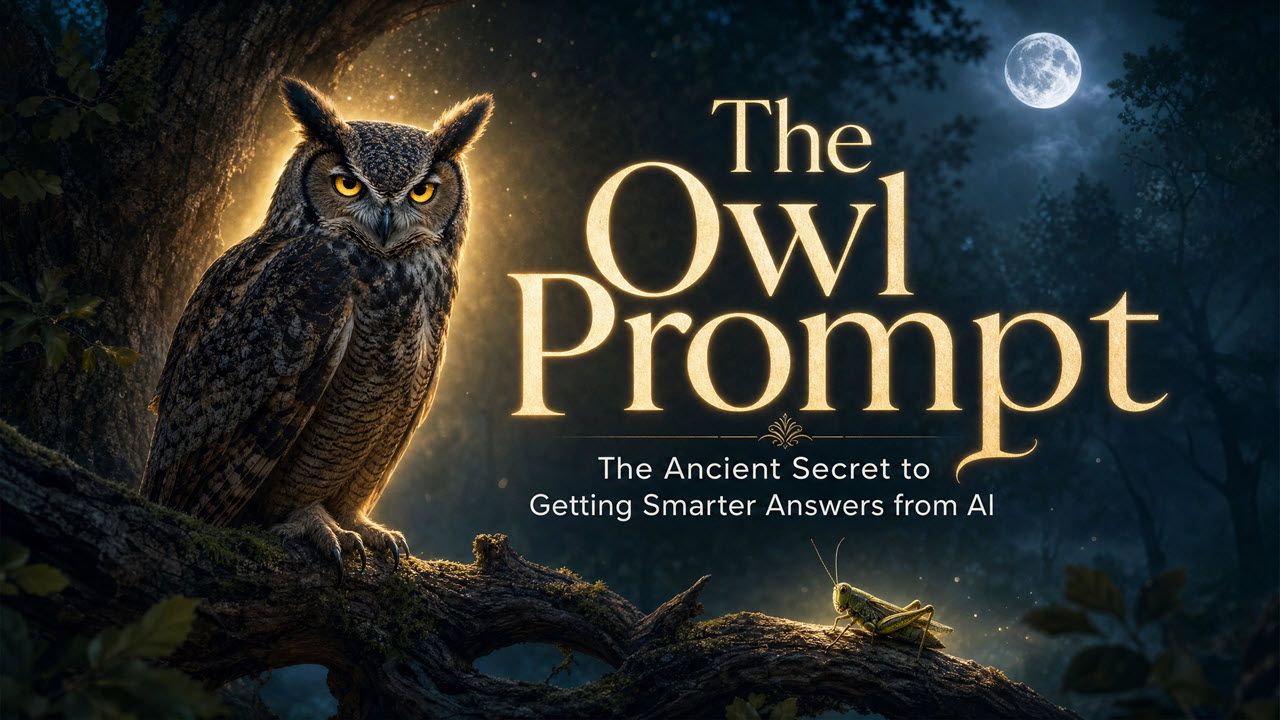
The Owl Prompt: The Ancient Secret to Getting Smarter Answers from AI
By Damon Nelson | Published [DATE] | Reading time: ~8 minutes
Originally inspired by Amanda Caswell's piece on Tom's Guide (May 1, 2026)
There is an old Aesop fable that most people have forgotten — or maybe never really understood.
An owl is trying to sleep in her hollow oak tree. A grasshopper nearby is chirping away, loud and obnoxious, completely unbothered by the owl's complaints. The grasshopper gets louder. The owl gets more frustrated. And for a moment, the owl considers flying out in broad daylight to deal with the problem head-on.
But she stops herself.
She knows her daytime vision is weak. She knows that rushing out blindly, reacting on impulse, would likely end in failure. So instead of reacting, she observes. She thinks. She changes her approach entirely — using patience and flattery to lure the grasshopper close enough to see clearly. And then, with perfect precision, she pounces.
The grasshopper never saw it coming.
That fable is roughly 2,500 years old. And it turns out it is also the most accurate description of what happens when you stop letting AI rush to the first answer — and instead teach it to think like an owl.
The Problem Nobody Talks About with AI
Here is something most content marketers, solopreneurs, and agency owners quietly experience but rarely say out loud: AI gives you fast answers that sound right but feel hollow.
You ask ChatGPT a real strategic question — something with actual stakes attached to it — and it comes back in four seconds with a polished, confident response. It is grammatically perfect. It is well-organized. It hits all the expected points.
And it completely misses the thing you actually needed to know.
That is not a bug in the system. It is a feature working exactly as designed. AI is optimized for speed and for sounding helpful. The problem, as Amanda Caswell noted in her recent piece for Tom's Guide, is that "sounds good" is not always the same as thinking deeply.
The result? You get surface-level answers to deep questions. You get the obvious solution without the hidden downside. You get the first-order thinking without the second-order consequences that will come back to bite you three months from now.
And you walk away feeling like AI is useful for simple tasks but not quite trustworthy for the decisions that actually matter.
That feeling is not wrong. But there is a fix — and it is one sentence long.
Meet the Owl Prompt
The prompt is this:
"Think like an owl — slow, observant and analytical. Examine this problem from multiple perspectives and identify the hidden factors most people overlook."
That is it. No complex multi-step framework. No 500-word system prompt. No elaborate chain-of-thought engineering. Just a single sentence that completely changes how the AI approaches your question.
The reason it works is elegant in its simplicity. You are not giving the AI more information — you are giving it a different operating posture. The owl metaphor carries a set of behavioral instructions the model already understands at a deep level: patience, quiet observation, multi-angle vision, and the discipline to wait until the moment is right before acting.
When you tell ChatGPT to "think like an owl," you are essentially telling it to stop performing helpfulness and start practicing wisdom. The model shifts from racing to the finish line to actually examining the terrain.
The difference in output is not subtle. It is the difference between a polished non-answer and a response that makes you lean forward in your chair.
Why the Owl Works When Other Prompts Don't
Most people who try to improve their AI results go about it the wrong way. They add more detail. They stack more instructions. They write longer prompts hoping that more input equals better output.
Sometimes that helps. But it does not solve the core problem, which is not about information — it is about approach.
The owl prompt works for the same reason the owl in Aesop's fable succeeded: it changes the strategy, not just the tactics. The owl did not try harder to chase the grasshopper in the daylight. She changed her entire method. That is what this prompt does for AI.
When the model adopts the owl posture, it begins to do four things it would not otherwise do:
| Without the Owl Prompt | With the Owl Prompt |
|---|---|
| Jumps to the most obvious answer | Breaks the problem down carefully before responding |
| Presents one solution | Examines multiple angles and competing perspectives |
| Skips over risks | Surfaces tradeoffs, downsides, and edge cases |
| Answers the question | Examines the question |
That last row is the one that matters most. There is a profound difference between an AI that answers your question and one that examines it. One gives you what you asked for. The other gives you what you actually need.
5 Real-World Applications for Marketers, Solopreneurs, and Agencies
The owl prompt is not a novelty. It is a practical tool — one that becomes more valuable the higher the stakes of the decision you are wrestling with. Here are five scenarios where it changes everything.
1. The Content Marketer Choosing a Pillar Topic
You have two strong content ideas competing for your Q3 editorial calendar. Both seem viable. Both have search volume. You need to commit to one — and the wrong choice means three months of effort pointed in the wrong direction.
The Owl Prompt:
"Think like an owl — slow, observant and analytical. Examine this problem from multiple perspectives and identify the hidden factors most people overlook: Should I focus our Q3 pillar content on 'AI Video Generation' or 'Automated SEO Workflows'? Our audience is mostly intermediate agency owners."
What the AI surfaces:
The obvious choice is AI Video Generation — it is trending, it has high search volume, and it feels timely. But the owl posture reveals the hidden downside: it is one of the most saturated topic categories online, and the content becomes outdated within weeks as tools evolve. You would be fighting for rankings in a crowded space with a short shelf life.
The less obvious alternative — Automated SEO Workflows — has lower search volume but solves a permanent pain point for agency owners: margin compression. A definitive guide on that topic builds long-term trust, ranks for years, and has significantly higher conversion intent from readers who are actively looking for a solution.
The owl does not just answer the question. It reframes the decision entirely.
2. The Solopreneur Pricing a New Course Launch
You have a new course ready to launch. You need cash now, but you also want to build a sustainable business. The classic dilemma: lifetime deal or monthly subscription?
The Owl Prompt:
"Think like an owl — slow, observant and analytical. Examine this problem from multiple perspectives and identify the hidden factors most people overlook: I am launching a new autoblogging course. Should I offer a $297 lifetime deal to get quick cash, or stick to a $47/month subscription?"
What the AI surfaces:
The obvious benefit of the lifetime deal is immediate revenue to cover launch costs. But the hidden downside is one that experienced course creators know all too well: lifetime buyers are often the most demanding on support, generate the most refund requests, and yield zero recurring revenue — which leads to a cash-injection hangover and burnout by month three.
The less obvious alternative is a hybrid model: a $47/month subscription with an annual pass at $397 that includes exclusive community access. The second-order effect is significant — the annual pass delivers the cash injection of a lifetime deal, but the psychological framing of a subscription filters out freebie-seekers and funds your growth without the support nightmare.
That is the kind of insight that used to require paying a business consultant. Now it takes one sentence.
3. The Marketing Agency Fixing Client Churn
Your agency is losing 20% of new clients within the first 60 days. You have a welcome packet. You have a kickoff call. You are doing the things you are supposed to do. And clients are still leaving before the work has a chance to produce results.
The Owl Prompt:
"Think like an owl — slow, observant and analytical. Examine this problem from multiple perspectives and identify the hidden factors most people overlook: Our marketing agency is losing 20% of new clients within the first 60 days. We currently send a welcome packet and have one kickoff call. How should we fix this?"
What the AI surfaces:
The obvious fix is to add more check-in calls and send more detailed reports. But the owl posture reveals the hidden downside: more calls overwhelm the client and eat directly into your agency's margins. Clients do not want more meetings. They want reassurance that they made the right decision.
The less obvious alternative is a "Quick Win" strategy in week two — something small and tangible, like fixing a broken Google Business Profile listing or optimizing a single high-traffic page — delivered before the main campaign launches. The second-order effect is the one that actually solves the churn problem: a minor, visible result in the first two weeks shifts the client's internal narrative from "Did I make a mistake hiring these people?" to "These people get things done." That emotional shift buys you the patience you need for the long-term work to compound.
One quick win in week two is worth more than six months of detailed reports. The owl saw that. The rushed answer never would have.
4. The Solopreneur Evaluating a Tech Stack Migration
You are running WordPress, ConvertKit, and ThriveCart. You are paying for three separate platforms. Someone in a Facebook group told you that GoHighLevel can replace all three and save you $150 a month. It sounds like a no-brainer.
The Owl Prompt:
"Think like an owl — slow, observant and analytical. Examine this problem from multiple perspectives and identify the hidden factors most people overlook: I am a solopreneur currently using WordPress, ConvertKit, and ThriveCart. Should I migrate everything to an all-in-one platform like GoHighLevel to save money?"
What the AI surfaces:
The obvious benefit is cost savings and the simplicity of a single login. But the hidden downside is the migration itself — a process that typically costs three to four weeks of lost momentum, broken funnels, and disrupted automations. The $150/month you save in year one gets consumed by the migration cost in the first quarter alone.
The less obvious alternative is to use Zapier or Make to better automate the connections between your existing tools, achieving the "all-in-one feel" without the migration risk. The second-order effect is the one that actually matters: specialized tools like ConvertKit and ThriveCart exist because they are better at their specific jobs than all-in-one platforms. Moving to GoHighLevel might save you $100 a month but cost you thousands in lost email deliverability and lower checkout conversion rates.
The grasshopper jumped at the shiny invitation. The owl would have stayed in the tree.
5. The Content Marketer Deciding Between YouTube and a Newsletter
You have 10 hours a week for content creation. You have an email list of 2,000 subscribers that you have built over two years. Someone tells you that YouTube is where the growth is. You are tempted to start a channel. But something feels off about abandoning what is already working.
The Owl Prompt:
"Think like an owl — slow, observant and analytical. Examine this problem from multiple perspectives and identify the hidden factors most people overlook: I have 10 hours a week for content creation. Should I start a YouTube channel to reach a new audience, or double down on my existing email newsletter of 2,000 subscribers?"
What the AI surfaces:
The obvious choice is YouTube — massive discoverability, compounding growth, and a platform that rewards consistency. But the hidden downside is brutal: 10 hours a week is barely enough to script, shoot, and edit one quality video, leaving zero time for promotion, community engagement, or maintaining your existing list. You would be starting from zero on a highly competitive platform while neglecting the audience you already have.
The less obvious alternative is to double down on the newsletter — but introduce a referral program and syndicate the content to LinkedIn and Medium for organic growth. The second-order effect is the one that changes the long game: nurturing your existing 2,000 subscribers builds a hyper-engaged core audience that becomes the guaranteed seed viewers when you do launch YouTube later. Channels that launch to an existing email list do not launch to crickets. They launch to momentum.
The owl does not abandon the tree that is already working. She builds the hunt from there.
When to Use It and When to Skip It
The owl prompt is not a universal replacement for every AI interaction. It is a precision tool for specific situations.
Use the Owl Prompt when you are making a decision with real tradeoffs and consequences, when you want to pressure-test a strategy before committing resources, when the right answer is not immediately obvious, or when you are about to spend significant time, money, or energy on something.
Skip it when you need a quick summary or a fast email draft, the task is straightforward and the stakes are low, or speed is the primary requirement.
The distinction matters. Reserve it for the decisions that deserve it, and it will consistently deliver the kind of insight that changes your direction.
The Deeper Lesson the Fable Was Always Teaching
Go back to that Aesop fable for a moment.
The grasshopper was loud, fast, and completely confident. He had an answer for everything. He reacted immediately to every provocation. And he ended up as dinner.
The owl was quiet, patient, and observant. She did not react to the noise. She did not rush into a situation where her limitations would work against her. She waited, she watched, and she chose her moment with precision.
For 2,500 years, that story has been filed under "a lesson about flattery." But there is a second lesson hiding in plain sight: the one who slows down, observes the full picture, and changes their approach wins — even when the other side is louder, faster, and more confident.
That is what the owl prompt does for your AI workflow. It does not make ChatGPT smarter in the technical sense. It changes the approach. It shifts the model from performing confidence to practicing wisdom.
Your Next Step
The next time you are facing a real decision — a pricing question, a content strategy call, a tech stack choice, a client retention problem — do not just ask AI what to do.
Ask it to think like an owl.
"Think like an owl — slow, observant and analytical. Examine this problem from multiple perspectives and identify the hidden factors most people overlook: [your question here]."
Paste that in. Read what comes back. Then compare it to the answer you would have gotten without it.
The difference will feel like the difference between a rushed reaction and a well-placed pounce.
The grasshopper never saw it coming. Neither will your competition.
Did this prompt change how you think about using AI? Drop a comment below and share the question you plan to run through it first.
This article was inspired by Amanda Caswell's original piece, "I used the 'Owl' prompt to make ChatGPT slow down — and it instantly gave me smarter answers," published May 1, 2026 on Tom's Guide. The Aesop fable referenced is "The Owl & the Grasshopper," archived by the Library of Congress.
About the Author: Damon Nelson is an entrepreneur, online marketer, and host of Geek Out Fridays — a bi-weekly show on AI, SEO, and automation for marketers and business owners. He is the creator of VidMasher, AIMasher, RSSMasher, and several best-selling courses on autoblogging and content syndication.
Stay connected with the most current Marketing News, Strategies, Tips , and Case Studies!
Join our monthly marketing magazine to receive the latest news and updates from our team of professional marketers and copywriters.
(Don't worry, your information will not be shared.)
Recent Posts
Expert Marketers Interviews
Listen to the Podcasts