
The SPINES Formula: The Sales Page Structure That Actually Converts Readers Into Buyers
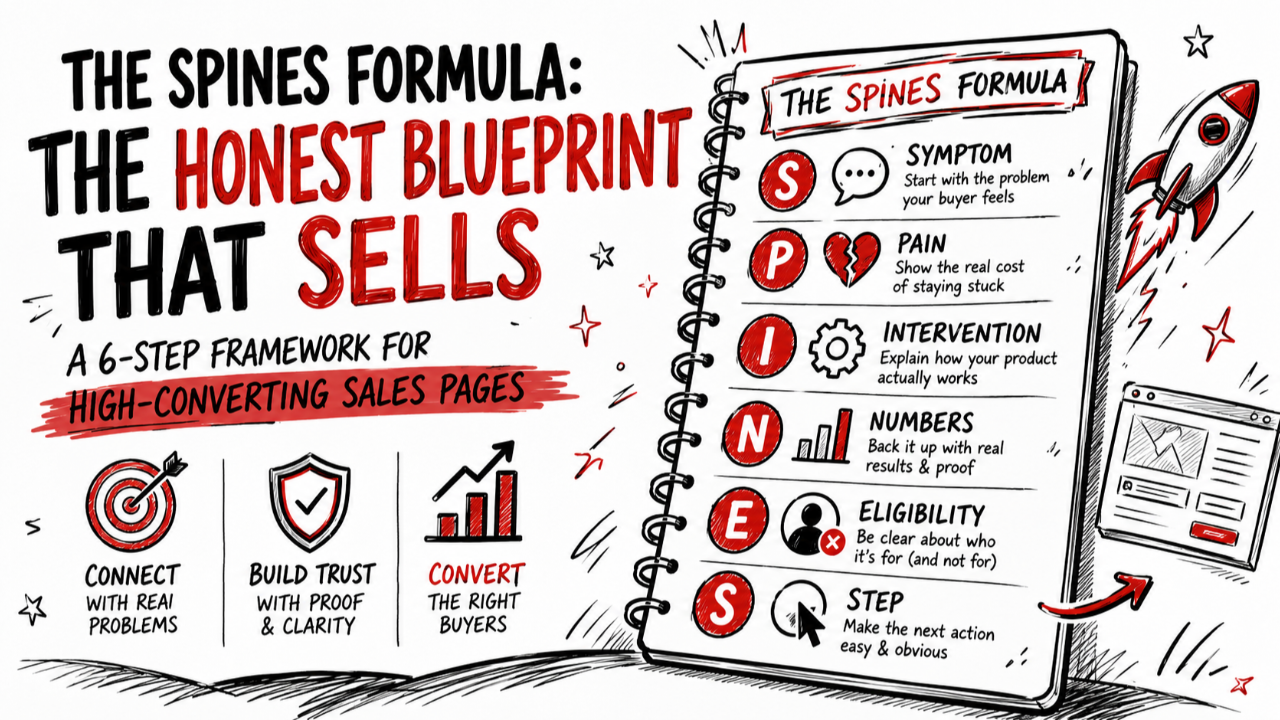
Most sales pages fail before anyone even reads them. They're either too vague, too pushy, or they bury the most important information where nobody looks. But what if there was a simple, honest formula that fixed all of that?
Today, we're breaking down the SPINES formula — a fresh approach to writing sales pages that sell. It's honest, it's clear, and it works. Let's dig in.
Why Most Copywriting Formulas Leave You Guessing
The Problem With "Sell the Destination" Advice
You've probably heard the classic advice: sell the dream, not the process. Show people the beach, not the long flight to get there. It sounds smart, but it's only half the story.
What if the journey is a dealbreaker for some people? What if being upfront about the hard parts actually builds more trust? Hiding the truth might get a click, but it won't keep a happy customer.
That's exactly where traditional formulas like AIDA, PAS, and PASTOR fall short. They focus on excitement and urgency. But they often skip two critical things: explaining how your product actually works and filtering out the wrong buyers before they purchase.
A Formula Born From Real Sales Pages
The SPINES formula was developed by reverse-engineering real, high-converting sales pages. It wasn't pulled from a textbook. It came from looking at what actually made readers say yes — and what made the right readers say yes.
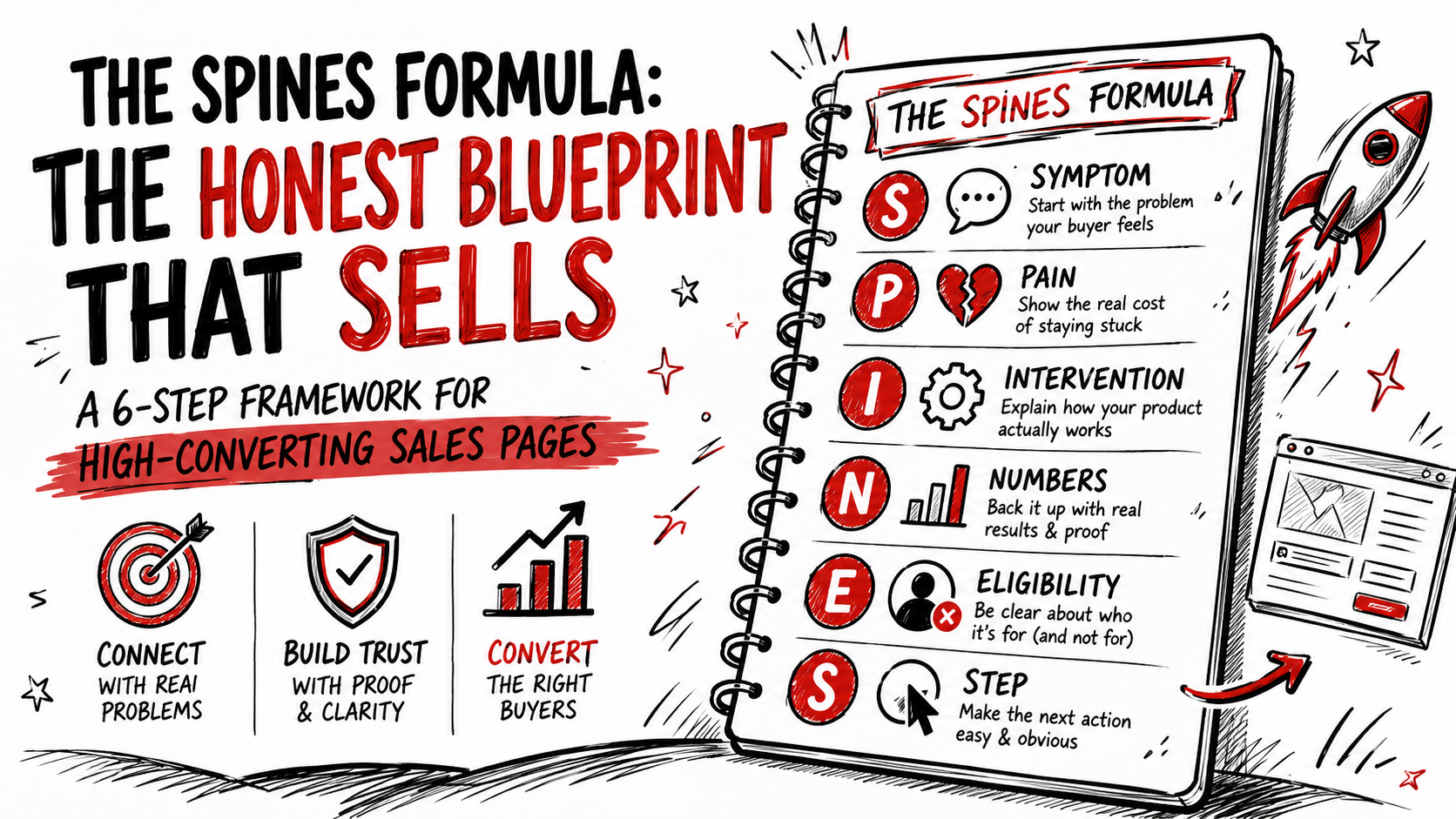
It's built on six steps. Each one does a specific job. Together, they create a sales page that feels honest, clear, and genuinely helpful.

Breaking Down the SPINES Formula Step by Step
S — Symptom: Start Where Your Buyer Already Is
The first step is simple: open with the problem your buyer is already complaining about. Don't dress it up. Don't make it poetic. Use their exact words.
Think about how your ideal customer would describe their frustration in a text message to a friend. That raw, unfiltered language is your opening line. When you start there, you immediately earn their attention.
- Use language from real customer emails, reviews, or DMs
- Keep it simple and conversational — no jargon
- Make the reader feel instantly understood
For example: "I spend hours making content and my sales are still flat." That's a symptom. It's the surface-level frustration your reader can immediately recognize in themselves.
P — Pain: Show What Staying Stuck Actually Costs
A symptom gets a nod. Pain gets people moving. This is where you dig deeper and show the real cost of doing nothing.
Pain isn't just emotional. It's measurable. Think about time lost, money wasted, momentum stalled, and opportunities handed to competitors. When you put a number on inaction, the mental math shifts. Suddenly, doing nothing feels more expensive than taking action.
- An unshipped product launch means another quarter of flat revenue
- Ten hours a week on posts that don't convert equals a full month of unpaid work each year
- A fuzzy strategy means competitors gain the ground you gave up
Pick one dimension of pain — money, time, or momentum — and quantify it. Show the compounding effect of waiting. That's what creates urgency without manipulation.
I — Intervention: Explain How Your Product Actually Works
Here's where most sales pages drop the ball. They introduce the product but skip the most important part: the mechanism. How does it actually produce the result?
Think of it like explaining a recipe to a friend. You don't just say "it tastes amazing." You say, "here's what goes in it and why it works." When readers can picture the gears turning, their belief goes up and their risk feels lower.
Why "Too Good to Be True" Kills Conversions
We've all seen bold claims like "make $10K a month working 10 minutes a day." Sure, it sounds amazing. But it also sounds like a lie. And if your follow-up is "buy this and I'll tell you how," people will leave.
Instead, show the mechanism. Walk them through the process in two to four clear steps. Something like: "Research → Decisions → Draft → Ship." That kind of clarity builds trust AND confidence that the reader can actually do this.
Building Credibility With Numbers and Proof
N — Numbers: Let the Evidence Do the Talking
You've explained how it works. Now show that it has worked. This is your proof section, and it needs to feel real — not like a highlight reel.
Think beyond just testimonials. Here's what strong proof looks like:
- Before-and-after metrics from real users
- Screenshots of results or product previews
- Short video clips or mini case studies
- A table of contents that shows exactly what's inside
Use your judgment here. Sometimes one powerful case study beats a wall of five-star reviews. Sometimes you need both. The goal is what you might call "credibility density" — enough proof to make belief feel reasonable.
The Most Overlooked Step: Filtering Your Buyers
E — Eligibility: Be Honest About Who This Is For
This is the step that separates good sales pages from great ones. Every strong sales page should include a clear "this is NOT for you if..." section. Yes, really.
Nothing is for everyone. And pretending otherwise doesn't just hurt your buyers — it hurts your business. Refunds, angry emails, and bad reviews are expensive. Telling the wrong person "no" is one of the best trust signals you can send the right person.
How Honest Filtering Actually Increases Sales
Here's the counterintuitive magic: when the wrong-fit buyer reads your "do not buy" section and sees themselves in it, they leave. Good. But when the right-fit buyer reads it and doesn't see themselves? They feel even more confident buying.
- Write three bullets describing who this is perfect for
- Write three honest bullets disqualifying the wrong buyer
- If possible, redirect wrong-fit readers to something more suitable
The key word here is honest. Don't write fake disqualifiers like "don't buy this if you want to stay broke." Give real, specific reasons. That honesty is what makes the whole thing work.
Closing the Sale With Absolute Clarity
S — Step: Make the Next Action Impossible to Miss
You've done all the hard work. Don't lose the sale now by making the checkout confusing. The final step is about radical clarity.
Tell your reader exactly what they get. Tell them how they'll access it. Tell them how long it takes. Then give them one single button to click. That's it.
- Avoid flowery language in your call-to-action
- One page, one decision, one button
- If they need a treasure map to find the CTA, all your hard work is wasted
Simple always beats clever at the finish line. The easier you make it to say yes, the more people will.
What SPINES Can't Do for You
The Honest Limitations of Any Sales Formula
Let's be real for a second. SPINES is a powerful framework, but it's not magic. There are two things it simply cannot do, no matter how well you execute it.
First, it cannot sell a bad product. At least not more than once. Second, it cannot tell you which pains and symptoms to talk about. That part requires real research — actual conversations with real buyers, reading their reviews, mining their emails and comments.
If you skip the research, you'll write a beautifully structured page full of educated guesses. And guesses don't convert. The formula works best when you already know your buyer's real language, real fears, and real frustrations.
Start Using SPINES on Your Next Sales Page
The SPINES formula gives you a clear, honest, and buyer-friendly structure for any sales page. It's not about hype or pressure. It's about clarity, trust, and helping the right people say yes with confidence.
Here's a quick recap of the six steps:
- Symptom — Open with the problem in your buyer's own words
- Pain — Show the real cost of staying stuck
- Intervention — Explain the mechanism, not just the promise
- Numbers — Provide real, specific proof
- Eligibility — Honestly filter who should and shouldn't buy
- Step — Give one clear, simple action to take right now
Ready to put this into practice? Pull up your current sales page — or start a brand new one — and work through each step of SPINES. You might be surprised how much clearer and more confident your writing becomes.
Have questions about applying the formula to your specific product or niche? Drop them in the comments below. Let's figure it out together.
Stay connected with the most current Marketing News, Strategies, Tips , and Case Studies!
Join our monthly marketing magazine to receive the latest news and updates from our team of professional marketers and copywriters.
(Don't worry, your information will not be shared.)


Recent Posts

Expert Marketers Interviews
Listen to the Podcasts