
You Don't Need to Be a Developer to Build a $5K/Month Software Business
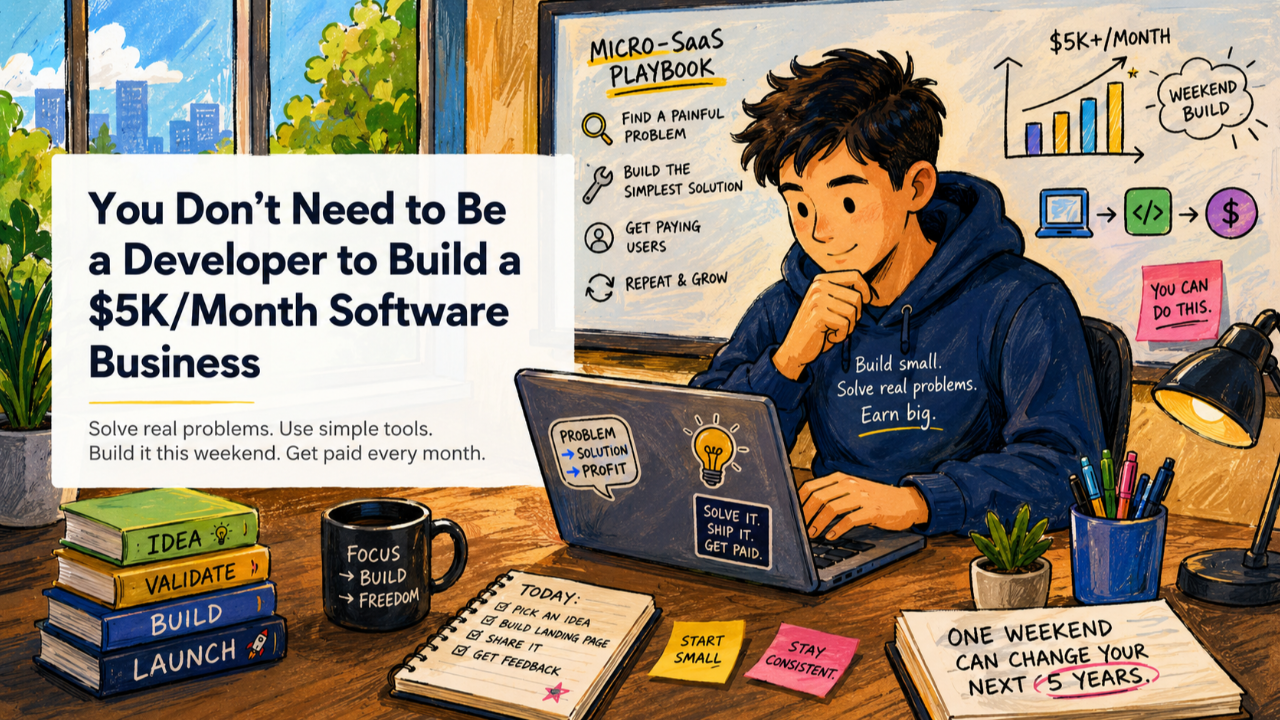
A solopreneur laid out nine simple software tools that target everyday office misery — and the math behind each one is quietly remarkable.
Right now, somewhere in a mid-size company, a marketing coordinator is spending her Tuesday afternoon manually converting whiteboard photos into presentation slides. She's been doing it every week for two years. Her company won't buy a $500,000 platform to fix it. But she'd pay $29 a month — on the company card, without blinking — for a tool that made it disappear by lunchtime.
That gap between "corporate won't fix it" and "I'll pay someone to fix it" is one of the most reliable business opportunities hiding in plain sight. And according to Zack Liu, who writes the Solopreneur Lab newsletter on Substack, you can build the tool that fills it over a single weekend — for as little as $11.58 a month in operating costs.
In a June 2026 breakdown, Liu mapped out nine of these "micro-SaaS" ideas in detail: the problem each one solves, the tools needed to build it, and exactly how many paying users it takes to generate $5,000 to $10,000 a month in recurring income. None of them require a developer. Most of them require less startup capital than a tank of gas.
The Reason No One Has Fixed This Yet
Enterprise software is built for the people who approve budgets, not the people who actually do the work.
That's not a cynicism — it's just the economics. A company isn't going to spend half a million dollars on a new platform because three people on the ops team waste two hours a week on a manual task. But those same three people? They'll reach for the corporate card without hesitation for a $29 tool that solves the specific problem making their Tuesday afternoon miserable.
"The easiest way to make money," Liu writes, "is to find a multi-step manual chore that people are forced to do every week and reduce it to a single drag-and-drop action."
That's the whole playbook. Find the task. Remove the steps. Charge a monthly fee. Repeat.
You Actually Don't Need to Know How to Code
Before getting into the nine ideas, it's worth addressing the thing that stops most people before they start: the assumption that building software requires knowing how to write software.
It doesn't — at least not for tools like these.
Liu's recommended build stack runs on tools designed for people who aren't developers. Carrd handles simple websites. Bubble.io creates the app interface. Make.com connects everything together without writing scripts. OpenAI and Google Gemini handle the AI-powered processing. The entire stack for most of these tools costs between $11 and $59 a month to run, and none of it requires touching a line of code if you don't want to.
That's not a workaround. It's legitimately how these things get built now.
Nine Problems. Nine Tools. Here's What Each One Does.
SlideQuick — You take a photo of a whiteboard or a screenshot of a dashboard. SlideQuick turns it into a clean, presentation-ready slide. That's it. No more wrestling with PowerPoint for an hour every time someone needs a visual. Runs for $11.58/month. Charges $29–$199/month. At 85 users on the mid-tier plan, it crosses $5,000/month.
PostPilot — Built for executives who want a LinkedIn presence but don't want to spend their evenings writing posts. You record a quick voice note on your phone. PostPilot transcribes it, strips the filler words, and sends back a finished post with a matching graphic — all through WhatsApp. No app to download. Runs for ~$16/month. Charges $49–$149/month. A hundred solo clients gets you close to $5,000/month.
VibeMatch — For everyone who's ever spent 20 minutes trying to figure out how to say "no" to a client without sounding rude. You paste your honest, unfiltered reaction. You pick a tone — Diplomatic, Firm, or Consultative. You get something back you can actually send. Runs for $33/month. Charges $12–$49/month.
ClearInbox — Slack was supposed to replace email. Instead it created a faster, louder inbox. ClearInbox monitors designated channels in the background and delivers a single clean checklist of actual action items every morning. No more context-switching all day just to catch what matters. Runs for $41/month. Charges $14/month per user.
QuickSOP — "Nobody wakes up excited to write a 40-page standard operating procedure manual," Liu notes — and he's right. When someone gives two weeks' notice, QuickSOP lets them record a short screen video walking through their job and converts it into a written procedure document automatically. The departing employee is done in 10 minutes instead of two days. Runs for ~$34/month. Charges $15–$39/month.
CompSpy — Marketing agencies currently spend hours manually clicking through competitor ad libraries and tracking landing page changes. CompSpy does it automatically every 48 hours and delivers a weekly summary of what shifted — new headlines, adjusted offers, changed angles. Runs for $59/month. Charges $99–$199/month.
DocuSketch — Internal communications teams write detailed policy updates that no one reads. DocuSketch takes that block of text and converts it into a visual one-page infographic that employees will actually look at — the kind of thing that gets pinned in a chat channel instead of ignored in a shared drive. Runs for $38/month. Charges $19–$29/month.
WhatsApp SnapClaim — Expense reporting through corporate portals is so painful that employees routinely delay it or lose receipts entirely. WhatsApp SnapClaim removes the portal entirely. Employees photograph their receipt and text it to a number. The tool reads the merchant, total, date, and currency and logs it automatically. "The absolute best enterprise software application," Liu writes, "is the one that requires zero user onboarding." Runs for $14/month. Charges $24–$79/month.
SheetsGenie — Finance analysts and HR coordinators hit spreadsheet walls constantly — a broken formula, a nested function they can't remember, an automation they don't know how to write. SheetsGenie takes a plain English description of what you want your cells to do and gives you the exact formula to paste in. That's the whole product. Runs for $11.58/month. Charges $9/month Pro. Five hundred subscribers generates $4,500/month. Eleven hundred gets you to $9,900/month.
The Part That Makes the Math Surprising
The gap between what these tools cost to run and what they can generate is the whole point.
SheetsGenie costs $11.58 a month to operate. At $9 a month per Pro subscriber, you need 500 paying users to generate $4,500/month in recurring income. That sounds like a lot until you consider that this is the kind of tool people find through a Google search when they're stuck — and those searches happen thousands of times a day.
SlideQuick, on the more expensive end, costs $11.58 a month to run and can generate just under $10,000/month with 50 agency clients on its $199/month corporate plan. The operating margin on that is almost comical.
This is why Liu's framing holds up: you're not trying to build the next Salesforce. You're trying to solve a specific Tuesday afternoon problem for a few hundred people who will pay you reliably every month to not have that problem anymore.
Before You Build Anything, Do This First
Liu closes with something more useful than a pep talk — a practical test for whether your idea will actually work before you spend time building it.
He calls it the one-hour validation challenge. The logic is simple: build a landing page that explains the problem your tool solves, put a payment link or a waitlist form on it, and share it on LinkedIn, X, or Reddit within 48 hours.
If people sign up, the idea is worth building. If they don't, you've learned something important without spending months building the wrong thing. Pick one idea from the nine — the one where you personally know people who deal with that frustration every week. Map out the simplest version. Build one page. Put a price on it.
Pick one. Build the page. Put it in front of people.
The rest is just iteration.
Stay connected with the most current Marketing News, Strategies, Tips , and Case Studies!
Join our monthly marketing magazine to receive the latest news and updates from our team of professional marketers and copywriters.
(Don't worry, your information will not be shared.)



Recent Posts

Expert Marketers Interviews
Listen to the Podcasts