
Your Sales Page Has Been Quietly Ghosting Your Customers
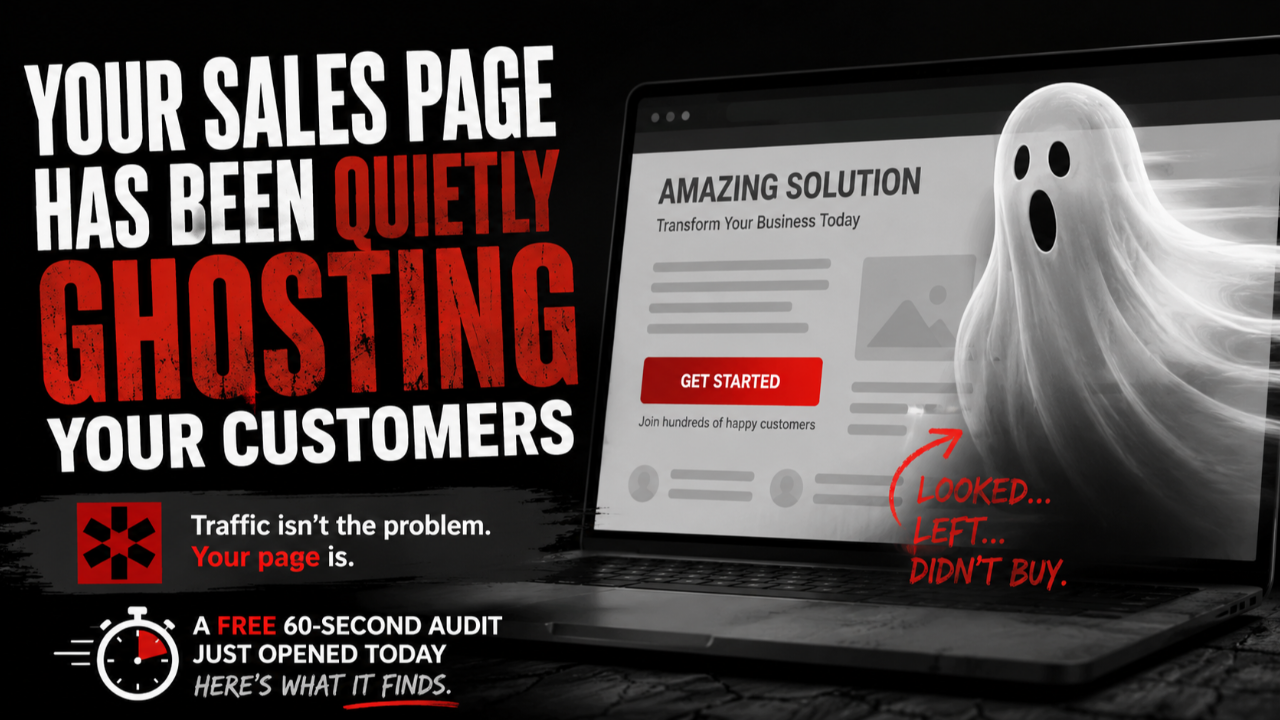
Traffic isn't the problem. Your page is. A free 60-second audit just opened today — here's what it finds.
You sent the email last week. Subject line was solid. Open rate was decent. People actually clicked.
And then your inbox just sat there. No PayPal notifications. No "I'm in" replies. Just a hundred people who showed up, looked at your page, and left without buying.
Most people blame the email. Or the offer. Or the algorithm. Or, if it's been a really rough month, Mercury in retrograde.
Almost none of those are the real problem.
You Got the Traffic. You Got the Silence.
Here's what makes a leaking sales page so expensive: it doesn't come with an error message.
It doesn't flash red. It doesn't send you a notification saying "hey, your headline is confusing people" or "your CTA buttons are working against each other." It just sits there looking perfectly fine while quietly converting at half the rate it should.
This invisibility is the trap. You can have a page that loads fast, looks polished, and has decent copy — and it's still bleeding conversions through one or two gaps that nobody ever pointed out. And because there's no alarm, most solopreneurs eventually just accept a conversion rate that's lower than it could be.
Then they go buy more traffic to pour into the same leaking bucket.
Your Page Isn't Broken — It's Just Keeping Secrets
Most sales pages have one or two core issues doing the majority of the damage. Not twelve things. One or two. And once you find them, fixing them isn't rocket science.
The problem is finding them without an outside eye.
Here's the thing nobody tells you: what your page looks like to you and what it does to a first-time visitor are two completely different experiences. You know the backstory. You know the offer. You see the page through six months of context. Your reader arrives cold, with three seconds of patience and a browser history full of pitches they've already ignored.
That gap is where conversions die.
So let's do something useful right now — pull up your sales page while you keep reading.
Let's Run Three Quick Checks Right Now (Yes, Actually Do This)
Check 1: The headline test. Read your headline out loud. Does it name the specific type of person it's written for — not "entrepreneurs" or "small business owners," but the person with the exact problem you solve? And does it say what changes for them — not a product feature, not a category label, but the actual result they're after?
If you can't answer yes to both in under ten seconds, you have a headline problem. And your headline is the most expensive real estate on your page. Most pages fail this check.
Check 2: The CTA audit. Scroll your whole page and count every button, link, and "click here" — including the link to your about page, your blog, your other products. Now count how many different places they send people.
Every decision you ask your reader to make beyond "buy this or not" is friction. One page, one goal. If your sales page is running five jobs at once, it's probably not closing any of them.
Check 3: The social proof placement test. Find your testimonials. Where are they sitting? A testimonial that arrives before your reader understands the problem being solved is just noise. A testimonial that lands right before your primary CTA — from someone whose before sounds exactly like your reader's right now — is one of the highest-conversion moves available to you.
Check yours. Is that what's happening? Or are they parked at the bottom as a formality?
If any of those three checks made you uncomfortable — good. That discomfort is the diagnosis working.
The Number That Changes How You Think About This
Here's the math that doesn't get talked about enough.
The average sales page converts somewhere between one and three percent. If yours is sitting at two percent and the right fixes push it to three, that's a 50% increase in revenue. Same offer. Same traffic. Same list.
On a $297 product with 500 monthly visitors, that single percentage point is worth $1,485 a month you're currently not collecting. Every month. Without touching your ad spend or writing a single new email.
Most solopreneurs work incredibly hard to drive more traffic to pages that have a slow, invisible leak. The leak is almost always cheaper to fix than the traffic costs to acquire.
The only reason they don't fix it first? Nobody ever told them exactly what was leaking.
What a $5,000 Copywriter Audit Finds — Now Free in 60 Seconds
A professional copywriter audit — the kind that actually identifies these issues — costs $1,500 to $5,000. For most solopreneurs running solid but not outrageous revenue, that's a hard number to justify every time you want to improve a page.
That's the gap SalesPageRescue was built to close.
You paste your URL. The tool runs your page through four conversion factors — the same dimensions an experienced copywriter would check on a paid engagement. The AI here isn't the expertise; it's the delivery mechanism that makes an expert-grade diagnostic framework instant and free. Within 60 seconds, the full report lands in your inbox with specific, actionable quick fixes. Not a "ten best practices" PDF. Actual identified issues, specific edits, ranked by impact.
I've spent years building tools for this audience — solopreneurs who know their marketing matters but can't always afford the agencies that service enterprise clients. This is the version of that feedback that doesn't require you to spend five grand or wait two weeks.
It Opens Today. Don't Leave Your Conversion Rate Where It Is.
SalesPageRescue goes live today.
If you've been running a sales page that gets traffic and doesn't convert the way it should — you can know exactly why in less time than it takes to make coffee. And "I don't know what's wrong with my page" stops being a valid reason not to fix it.
Go to salespagerescue.com. Paste your URL. Get your report.
Most pages have one or two things doing the majority of the damage. The audit finds them. After that, you're just fixing what you now know is broken — which is a completely different feeling than guessing.
The 60 seconds costs you nothing. The leak costs you every month you don't fix it.
Damon Nelson is a direct response marketer, automation strategist, and co-founder of Launch Ninjas, Inc. He hosts GeekOutFridays — a live weekly session for solopreneurs who run lean, automate smart, and want their marketing to work while they're not watching.
Stay connected with the most current Marketing News, Strategies, Tips , and Case Studies!
Join our monthly marketing magazine to receive the latest news and updates from our team of professional marketers and copywriters.
(Don't worry, your information will not be shared.)



Recent Posts

Expert Marketers Interviews
Listen to the Podcasts