
Go-to-Market Strategy: The Practical GTM Playbook to Launch and Get Paying Customers Fast
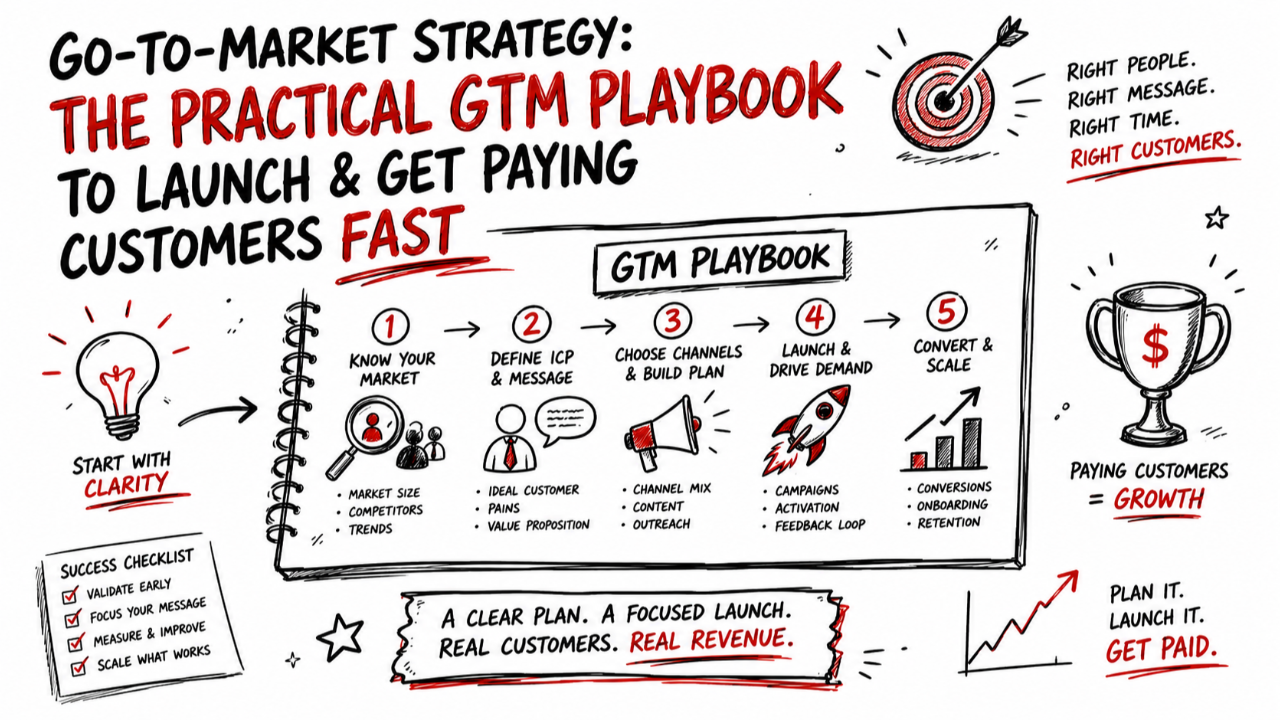
Execution is the only thing that pays the bills in the creator economy. A great product is not a moat anymore. It is the entry fee.
I learned that the hard way in corporate tech. Teams built “perfect” software for months, then launched to silence.
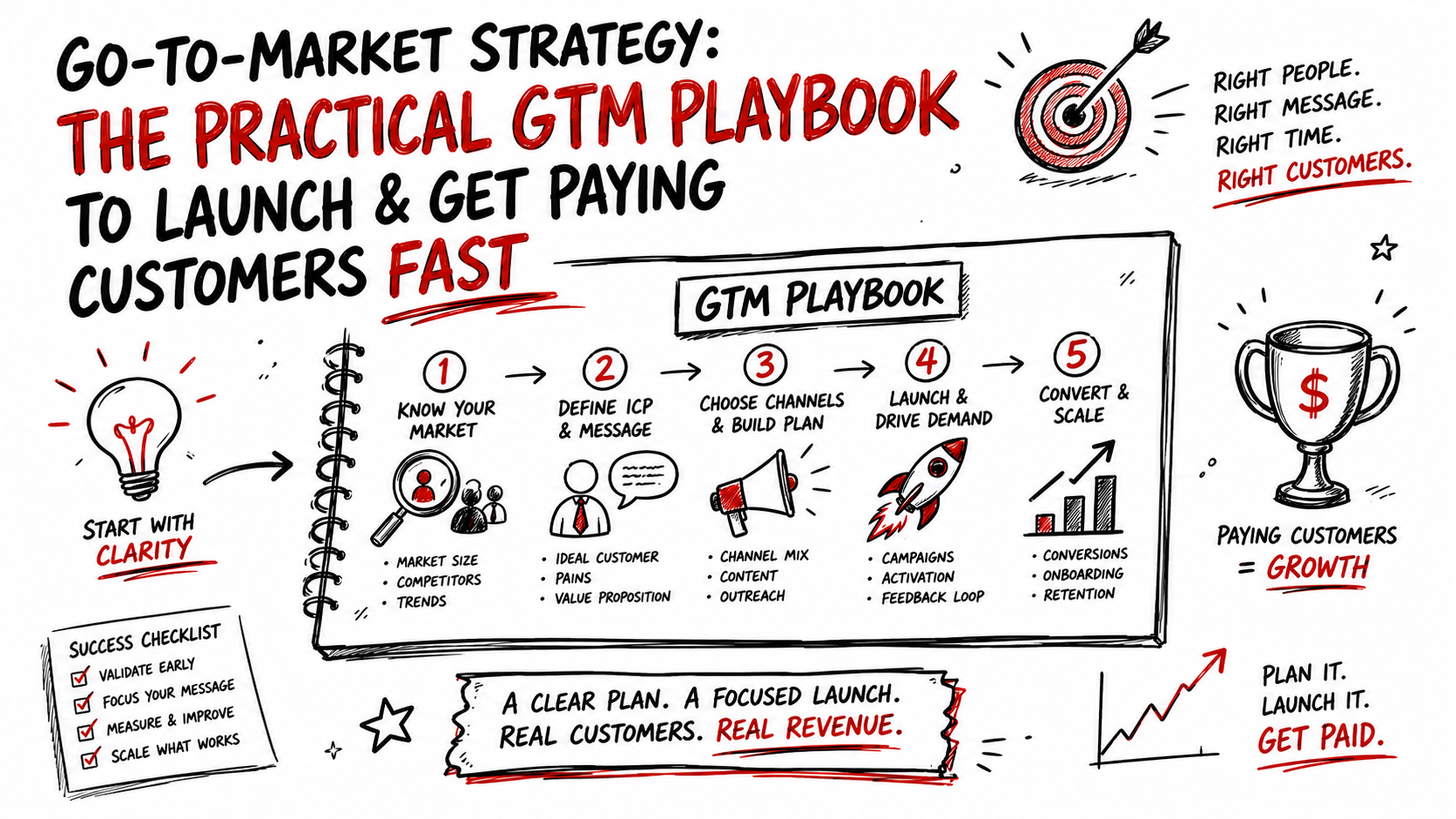
So when I became a solo builder, I made a rule. I would never launch on hope. I would launch with a Go-to-Market strategy that forces reality early.
1) What a Go-to-Market (GTM) Strategy Really Is
A simple definition you can actually use
A Go-to-Market strategy is your launch blueprint. It tells you who you sell to, what you say, where you show up, and how you get paid.
It also ties your product, marketing, sales, and support into one plan. That way, your launch does not feel like chaos.
GTM vs. business plan vs. marketing plan
People mix these up all the time. But they solve different problems. If you use the wrong one, you will drift.
- Business plan: Big-picture viability. Runway, costs, and long-term financials.
- Marketing plan: Brand and demand over time. Content, awareness, and campaigns.
- GTM strategy: A focused launch plan for one offer. It is tactical and time-bound.
A quick example that makes it click
Say you build a tool that reconciles invoices for freelance designers. Your business plan covers hosting costs and your personal runway.
Your marketing plan covers long-term blog posts about freelancing. Your GTM plan targets the first 500 designers and converts them in 30 days.
Why GTM gives you an edge right now
When you nail GTM, you stop guessing. You move faster and waste less money.
- Faster launches: Clear steps remove bottlenecks.
- Lower risk: Early validation prevents expensive dead ends.
- Better onboarding: Your product matches real buyer expectations.
- One story everywhere: Sales and marketing stop contradicting each other.
As I like to put it, “A brilliant product with a broken entry plan is just a fancy way to lose money.”
2) Market Intelligence: Pick a Beachhead or Get Ignored
Why “everyone” is not a real target
If you target everyone, you become invisible. Your message gets watered down until nobody feels it.
You need a beachhead. That is your first narrow group that buys fast and gives strong feedback.
Use market sizing as your reality check
Market sizing sounds academic, but it protects your time. It tells you if the opportunity is big enough to chase.
Break it into four layers so you can think clearly.
- TAM: The biggest possible market if you owned the whole category.
- SAM: The slice you can serve with your current product and reach.
- SOM: What you can realistically win in the next 12–24 months.
- PAM: The expanded market you could unlock if the category grows.
Three ways to estimate your market without fooling yourself
Do not trust one method. Cross-check your numbers like you would check a recipe twice.
- Top-down: Start with industry reports, then filter down. Fast, but assumption-heavy.
- Bottom-up: Count real buyers, then multiply by expected annual value. Great for planning.
- Value-based: Price based on time or money saved. Best for new categories.
Track competitors without wasting your life
You do not need to stalk competitor websites daily. You need a simple system that runs in the background.
- Known rivals: Same buyer, same problem. Check weekly.
- Alternative solutions: Spreadsheets, agencies, manual work. Check monthly.
- Rising challengers: New startups and pivots. Check quarterly.
- Potential disruptors: Tech shifts that kill categories. Check yearly.
Steal insight from “three-star” reviews
Five-star reviews are too glowing. One-star reviews are often emotional. Three-star reviews are pure gold.
They show what users like, but also where they struggle. That is where your pitch gets sharp.
- Pull three-star reviews from platforms like G2 or Capterra.
- Turn each complaint into a line in your outreach or landing page.
- Use competitor job posts as signals of where they are heading next.
3) Build Your ICP and Speak to Real Humans
Your Ideal Customer Profile (ICP) is your filter
Your ICP is the “perfect account” that feels the pain most. It is also the account that gets the biggest win from your product.
Build it with four pillars so it stays grounded.
- Firmographics: Industry, size, location, revenue.
- Technographics: Tools they already use and must integrate with.
- Operational triggers: Growth spurts, leadership changes, broken workflows.
- Economic reality: Budget, buying cycles, and who can approve spend.
Remember: committees buy, not companies
In B2B, one person rarely decides alone. You often face a small group with different fears and goals.
Map your message to these common roles.
- Initiator: Feels the pain first and starts searching.
- User: Lives in the tool daily and wants speed.
- Influencer: Reviews security and technical fit.
- Decision maker: Approves based on ROI and strategy.
- Buyer: Handles procurement, terms, and payment.
A one-page matrix beats a 50-page report
Here is a simple exercise you can do this week. Put target accounts on the left and buyer roles on top.
Then fill each box with one real competitor complaint. Now your outreach feels personal, not generic.
4) Positioning and Messaging: Make Your Product Obvious
Positioning is context, not clever words
If buyers cannot place you in their world, they will scroll past. Your job is to make the category and value clear fast.
Think of positioning like a label on a jar. Without it, nobody knows what they are holding.
The 5+1 parts of strong positioning
You can build strong positioning without fancy branding. You just need the right ingredients.
- Competitive alternatives: What they use today instead of you.
- Unique attributes: What you do that others cannot copy easily.
- Demonstrable value: The measurable outcomes you create.
- Target market: The specific segment that cares most.
- Market frame: The category that sets expectations on price and features.
- Trend layer: The “why now” that adds urgency.
Pressure-test your message before you scale
You do not need a big budget to test messaging. You need small experiments with clear signals.
- Landing page A/B test: Same layout, different headline. Track email signups.
- Cold email test: Two value themes, 500 prospects each. Track replies.
Keep your core line simple. Use this formula: “We help [target] do [outcome] by removing [friction].”
5) Pricing and Packaging: Choose a Model That Matches Value
Pricing is not a one-time decision
Founders often freeze when they hit the pricing page. But pricing is a tool you adjust as you learn.
Even small changes can improve growth. The key is to match pricing to how customers get value.
Five common pricing models and when to use them
- Per-seat: Simple and predictable, but can limit adoption.
- Usage-based: Great for developer tools, but less predictable revenue.
- Tiered plans: Easy to understand, but only works if tiers match real segments.
- Hybrid: Base fee plus usage. Powerful, but harder to explain.
- Outcome-based: Aligns incentives, but requires clean tracking.
Freemium vs. free trial: pick your trade-off
Freemium can bring lots of users, but it adds support and hosting costs. Free trials create urgency and screen for intent.
Whichever you choose, do not block the “aha moment.” Gate admin and scale features instead.
6) Sales Motions and Channels: Match Price to Friction
Three variables decide how you should sell
Your sales motion is not a vibe. It is math and behavior.
Use these three inputs to choose your engine.
- ACV: Your annual contract value sets your CAC ceiling.
- Decision process: Solo buyer or committee with procurement.
- Time-to-value: How fast users reach a real win.
The three common sales engines
- Self-serve (PLG): Best for low ACV and fast time-to-value.
- Hybrid: Product-led entry with sales help to expand accounts.
- Enterprise sales (SLG): Needed for high ACV and complex setups.
A four-step way to pick channels without chaos
- ACV filter: Cut channels your price cannot support.
- Demand filter: Active search favors inbound. Hidden problems need outbound.
- Stage filter: Pre-fit? Focus on one channel first.
- Conflict check: Make sure channels do not fight over the same accounts.
If you are solo, default to self-serve and fast time-to-value. If you must explain it on calls, price like a service, not an app.
7) Launch Execution and Retention: Where GTM Actually Lives
Strategy lives in your calendar, not your deck
A GTM strategy fails when it stays theoretical. You need a short execution plan with owners and deadlines.
Think in three phases: pre-launch, launch week, and post-launch.
A simple three-phase launch checklist
- Pre-launch (weeks before): lock messaging, build assets, train support, run a go/no-go review.
- Launch week: ship code, push campaigns, run outreach, watch onboarding friction.
- Post-launch (days 7–90): fix leaks, review results, drive adoption and upgrades.
Measure what keeps your business alive
Acquisition gets attention, but retention pays rent. You need weekly metrics that tell the truth.
- CAC: Total cost to win one customer.
- LTV: Gross margin revenue per customer over their lifetime.
- LTV:CAC: Aim for at least 3:1 to survive.
- Activation rate: Percent who hit the value milestone in week one.
- Sales cycle length: Days from first touch to payment.
Run a monthly “GTM leak audit”
Do not panic and change everything at once. Find the biggest drop-off point in your funnel and fix only that.
Then measure again in four weeks. This keeps your learning clean and your runway safe.
What You Can Do in the Next 90 Days
A practical 7-step GTM sprint
- Pick a beachhead segment using bottom-up market math.
- Write a one-page positioning brief with real alternatives.
- Choose one value metric for pricing and packaging.
- Select your sales motion based on ACV and time-to-value.
- Sync outbound outreach with inbound content that answers objections.
- Assign clear owners for readiness, narrative, and revenue path tasks.
- Run a leak audit every 30 days and fix one bottleneck at a time.
The guesswork launch is dead. If you want traction, build the blueprint and run it.
If you’re building something right now, tell me your product and your target buyer. I’ll help you pick a beachhead and a first GTM test.
Stay connected with the most current Marketing News, Strategies, Tips , and Case Studies!
Join our monthly marketing magazine to receive the latest news and updates from our team of professional marketers and copywriters.
(Don't worry, your information will not be shared.)


Recent Posts

Expert Marketers Interviews
Listen to the Podcasts