
Three Developers, Three Blogs, One Phone - The Quiet Arrival of Pocket Publishing
Three Developers, Three Blogs, One Phone
The Quiet Arrival of Pocket Publishing
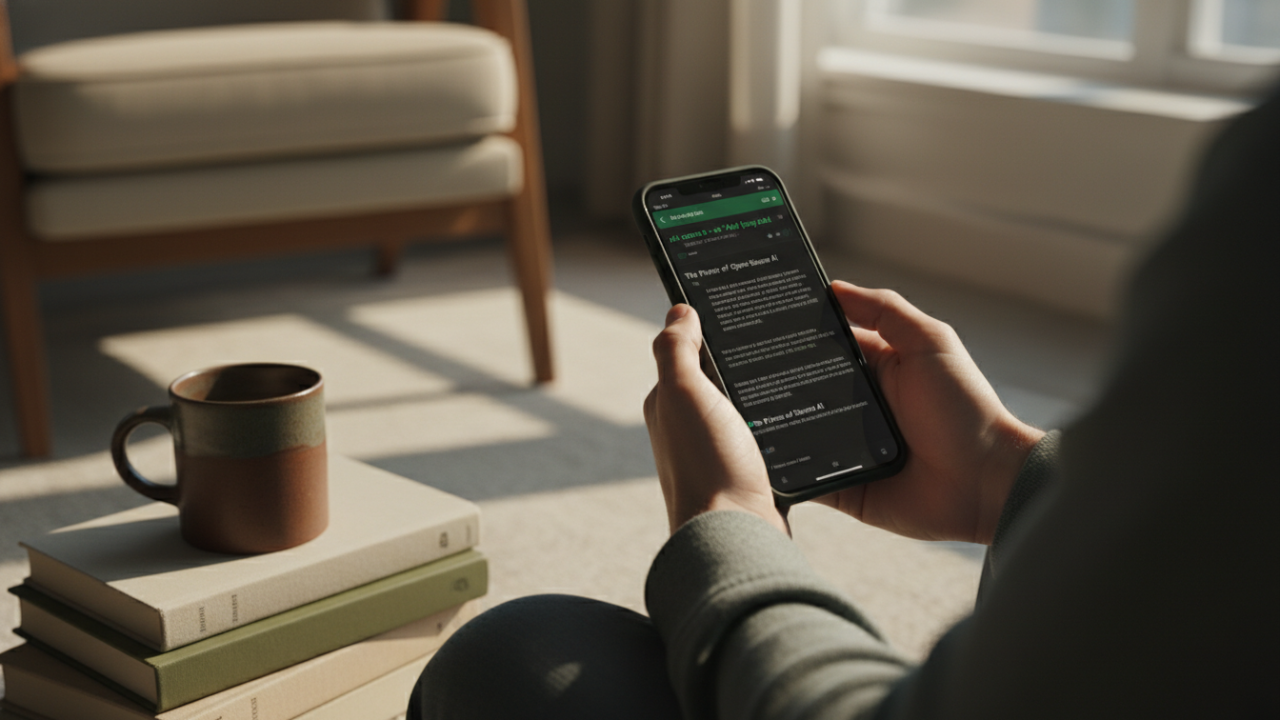
Between October 2025 and January 2026, three independent developers — working on separate stacks, in different cities, with no apparent coordination — published nearly identical accounts of the same workflow. Each had written and shipped blog posts to their personal sites using the Claude mobile app on iPhone. None had opened a laptop to do it.
The pattern is small but worth recording. It marks the first wave of public documentation on what mobile coding agents actually do when handed an everyday job rather than a benchmark.
The First Account: A Sunday Afternoon on the Couch
Designer and writer Jonny Burch published Writing Blog Posts with Claude Code on iOS on October 20, 2025. The post opens with a disclosure: "I wrote none of the below. Read it and you'll understand why."
Burch's blog is an Astro site. His prior routine, as he describes it, was the standard one — laptop, Cursor or another editor, a new markdown file with the right frontmatter, then a git commit and push. Anthropic's release of Claude Code for iOS collapsed those steps into a conversation.
"The iOS app brings Claude Code's capabilities to my pocket. Not in a watered-down, 'mobile-friendly' way, but with full access to the same tools and workflows I use on desktop."
He listed the workflow in five lines: open the app, ask Claude to explore the blog structure, instruct it to write a post about the workflow, review and refine, commit and push. He clocked the round trip at about ten minutes, written from his bed.
The piece ends on a note of measured surprise. The tool didn't replace him, he wrote — it captured what he wanted to say "in my voice, formatted correctly for my blog, committed to the right branch, and ready to publish."
The Second Account: A How-To, From the Subject Himself
Three months later, on January 23, 2026, Peter Warnock — a full-stack developer and DevOps engineer whose site documents tools including a multi-agent workspace manager called Gastown — published Publishing Blog Posts with Claude Code on iPhone. His post is longer, more procedural, and ends with a one-line disclosure that mirrors Burch's: "This post was created entirely using Claude Code in the Claude mobile app on iPhone, committed to Git, and deployed to peterwarnock.com — without touching a laptop."
Warnock's blog runs on Hugo. His account itemizes the affordances that make a mobile session worth the trouble: file operations, git integration, command execution, and multi-file context. The mechanics, in his telling, run on natural language. He starts with a brief — "Create a blog post about X. The post should explain Y and include examples of Z." — and Claude reads existing posts to infer frontmatter requirements and tone before writing a line.
"Publishing this blog post from my iPhone — using Claude Code to create the file, format the frontmatter, and push to Git — feels like science fiction. But it's real, it's practical, and it's changing how I create content."
He lists, in passing, where he has published from: airport lounges, coffee shops, his backyard, "late night from bed (this is dangerous for productivity)." He also names the trade-offs. Image work, large refactors, and complex debugging still belong on a desktop. Pure content creation, in his account, does not.
The Third Account: A Dissenting Note From Stan Lo
The countercase came on January 11, 2026, from Stan Lo — a Ruby developer who blogs at st0012.dev. His post, Fixing My Blog from My Phone with Claude's Code Sessions (NOT Claude Code), makes a careful distinction Burch and Warnock did not. He used the Claude app's Code sessions — the cloud-VM interface inside the mobile app — rather than the Claude Code CLI ported to iOS.
The work itself succeeded. Lo noticed responsiveness issues on his blog while out, asked Claude to debug them from his phone, reviewed the changes, and pushed a fix that triggered a deploy. But the rough edges were specific and documented.
"The cloud environment won't match your local setup."
Lo's Jekyll site runs on chruby and Ruby 4.0.0. The Claude-managed VM, he reports, defaults to rbenv and Ruby 3.3.6. Claude tried to follow his CLAUDE.md instructions, failed at the environment level, and gave up on building the site to verify its own fix. He had to push from the phone, sort out the environment in a follow-up commit, and re-verify. He flagged two more constraints: no editor view of changes as they happen, and what appeared to be a one-PR-per-session limit ("after my first PR was merged, I tried adding follow-up changes in the same session. Neither pushing to the rebased branch nor creating a new branch made Claude realize it needed to create a different PR — the UI kept showing the old, merged one").
He closed without overclaiming.
"I'm genuinely excited that I can now address website issues and publish content from my phone. The experience was good enough that I'll probably use it again. I'm less excited about hearing 'You can fix this on your phone' in the future."
What the Three Accounts Have in Common
Each writer worked alone. Each used a different static-site generator — Astro, Hugo, Jekyll. Each documented the same step list: invoke the app, point it at the repository, brief it on intent, review, commit, push, deploy. None reported a breakthrough; all reported a removed step. The friction subtracted is the step where they had to be at a desk.
The accounts also share what they do not claim. None of the three argued that mobile sessions replace desktop work for substantial development. Warnock named the limits — image editing, complex debugging, large refactors. Lo named the cloud-VM mismatch. Burch named the small-screen problem with large diffs. The claim, in each case, is narrow: for writing and publishing a blog post, the laptop became optional.
How we verified this
Each subject's blog post was located by direct search, fetched in full from the author's own domain, and cross-checked against their public profiles on GitHub, LinkedIn, and X/Twitter. All direct quotations in this article are reproduced verbatim from those posts, with the publication dates as displayed by each subject. No aggregator articles or AI-generated summaries were used.
Sources
- Jonny Burch, Writing Blog Posts with Claude Code on iOS, October 20, 2025 — https://jonnyburch.com/writing-blog-posts-with-claude-code-ios/
- Peter Warnock, Publishing Blog Posts with Claude Code on iPhone, January 23, 2026 — https://peterwarnock.com/blog/posts/publishing-with-claude-code-iphone/
- Stan Lo, Fixing My Blog from My Phone with Claude's Code Sessions (NOT Claude Code), January 11, 2026 — https://st0012.dev/2026/01/11/fix-my-new-blog-from-my-phone-using-claude/
Stay connected with the most current Marketing News, Strategies, Tips , and Case Studies!
Join our monthly marketing magazine to receive the latest news and updates from our team of professional marketers and copywriters.
(Don't worry, your information will not be shared.)
Recent Posts

Expert Marketers Interviews
Listen to the Podcasts